

Introduction
You promised yourself this would be the last time.
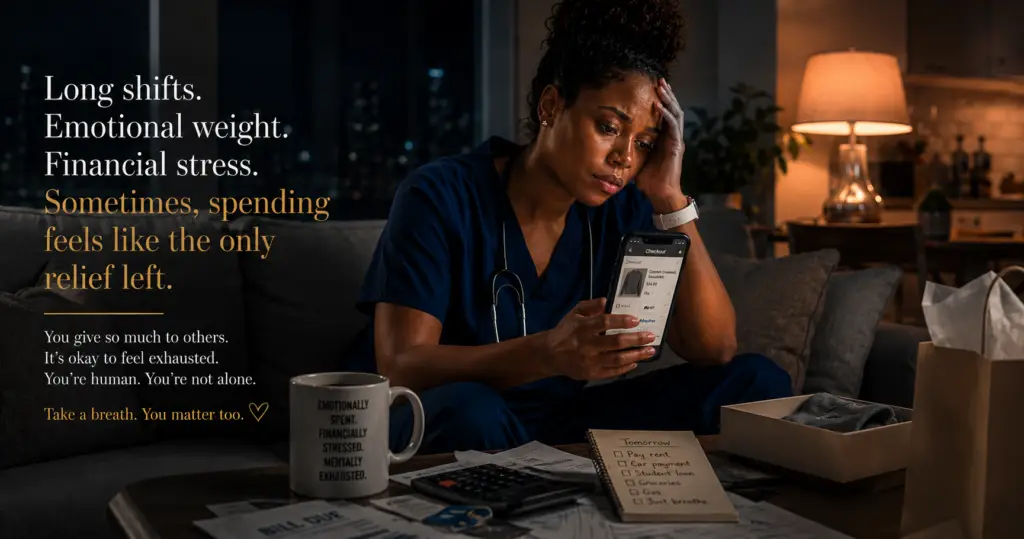
After another exhausting twelve-hour shift, you climbed into your car feeling emotionally drained. You skipped lunch because the unit was short-staffed. You comforted grieving family members, responded to call lights without stopping, charted late into the evening, and barely had enough energy to think about dinner.
On the drive home, cooking felt impossible.
So you ordered takeout.
Later that night, while lying in bed trying to quiet your mind, you opened Amazon “just to browse.” A few clicks later, a package was on its way. Maybe it was a new pair of scrubs, a candle, skincare products, kitchen gadgets, or something that simply felt like a reward for surviving another difficult day.
For a brief moment, it felt comforting.
Then the feeling faded.
The next morning, the charges were still there—but the relief was gone.
If this sounds familiar, you’re far from alone.
Many nurses experience a pattern known as emotional spending—using purchases to cope with stress, emotional exhaustion, or burnout. It doesn’t mean you’re irresponsible, impulsive, or incapable of managing money. In fact, many financially responsible nurses find themselves caught in this cycle after months or years of working in high-pressure healthcare environments.
Nursing is emotionally demanding in ways that few professions can fully understand. Every shift requires constant decision-making, compassion, critical thinking, and emotional resilience. You care for people during some of the most difficult moments of their lives while often neglecting your own physical and emotional needs. When your shift finally ends, your brain naturally searches for relief.
Sometimes that relief looks like food delivery.
Sometimes it looks like online shopping.
Sometimes it looks like convincing yourself that you “deserve” one more purchase because the day was so hard.
The problem isn’t wanting comfort. The problem is when spending becomes the primary way you recover from emotional stress.
Over time, these seemingly small purchases can quietly contribute to credit card balances, delayed savings goals, financial anxiety, and feelings of guilt. The result is a cycle that’s difficult to break: work creates stress, stress leads to spending, spending creates financial pressure, and financial pressure increases stress before the next shift even begins.
The encouraging news is that this cycle can be changed.
Understanding why emotional spending happens is the first step toward replacing guilt with awareness and building financial habits that support both your mental health and your long-term goals.
In this guide, you’ll learn:
- Why burnout changes the way nurses make financial decisions.
- The science behind emotional spending and stress.
- How to recognize your personal spending triggers.
- Practical strategies to regain control of your finances without relying on willpower alone.
- Healthy ways to reward yourself that don’t derail your budget.
- How to build lasting financial confidence while still enjoying the career you’ve worked so hard to achieve.
You dedicate your career to helping other people heal. It’s time to apply that same compassion to yourself—and to your financial life.

Why Emotional Spending for Nurses Is So Common
If you’ve ever wondered why you seem to spend more money after difficult shifts than on your days off, the answer has less to do with willpower than you might think.
Emotional spending for nurses is often a response to the unique physical and emotional demands of the profession. Nursing requires constant decision-making, compassion, multitasking, and resilience. By the time your shift ends, your mind and body are searching for relief—and spending money can feel like the quickest way to find it.
Unlike many careers, nursing doesn’t simply end when you clock out. You may carry the emotional weight of difficult patient outcomes, understaffing, missed breaks, demanding workloads, or the pressure of knowing every decision can affect someone’s life. Even when you’re home, your brain may still be processing everything that happened during your shift.
This emotional overload makes nurses especially vulnerable to what psychologists call reward-seeking behavior—the natural tendency to look for something that feels good after experiencing prolonged stress.
For some nurses, that reward might be:
- Ordering food instead of cooking.
- Buying new scrubs or shoes.
- Shopping online before bed.
- Treating themselves to coffee every morning.
- Booking an impromptu weekend getaway.
- Upgrading gadgets or household items they weren’t planning to buy.
None of these purchases are inherently bad. In fact, enjoying the money you earn is part of a healthy financial life. The challenge begins when spending becomes your primary coping mechanism rather than an occasional reward.
Nursing Creates the Perfect Environment for Emotional Spending
Many professions are stressful, but nursing combines several factors that can make emotional spending more likely.
Decision Fatigue
During a typical shift, nurses make hundreds of decisions. From medication administration and patient assessments to prioritizing care and responding to emergencies, every choice requires mental energy.
By the end of a long shift, your brain is tired.
Research suggests that when people experience decision fatigue, they are more likely to seek immediate gratification instead of making long-term decisions. That can make it harder to resist impulse purchases or stick to a budget.
Emotional Labor
Nurses don’t just perform clinical tasks—they manage emotions.
You comfort grieving families, reassure anxious patients, support coworkers, and remain calm during emergencies, even when you’re feeling overwhelmed yourself.
This invisible emotional work is exhausting, and your brain naturally looks for ways to recover afterward.
For many people, buying something enjoyable provides a brief emotional lift.
Compassion Fatigue
Giving your emotional energy to others day after day can leave you feeling depleted.
When compassion fatigue sets in, self-care often shifts from healthy habits—like rest, exercise, or spending time with loved ones—to quick sources of comfort such as shopping, takeout, or impulse purchases.
These choices aren’t signs of weakness. They’re often signs that your mind is trying to recover from prolonged emotional stress.
Chronic Stress and Burnout
Burnout develops over time, not overnight.
Working short-staffed, missing breaks, rotating shifts, mandatory overtime, and caring for high-acuity patients can gradually drain your emotional and physical reserves.
When stress becomes chronic, your brain begins to prioritize immediate comfort over future rewards. Saving for retirement, paying down debt, or sticking to a budget can suddenly feel less urgent than doing something that provides relief right now.
That’s why emotional spending often increases during periods of burnout.
It’s Not About Being Bad With Money
Many nurses blame themselves after an impulse purchase.
You might think:
“I should know better.”
“Why can’t I stick to my budget?”
“I work so hard, but I never seem to get ahead.”
These thoughts are understandable, but they’re often based on the mistaken belief that emotional spending is simply a lack of discipline.
In reality, financial habits are influenced by emotions, stress, environment, and daily experiences—not just knowledge or willpower.
Recognizing that connection is empowering because it shifts the question from “What’s wrong with me?” to “What need am I trying to meet?”
Once you identify the emotional triggers behind your spending, you can begin replacing automatic spending habits with healthier ways to recover from difficult shifts while still honoring the hard work you do every day.
The first step isn’t spending less.
It’s understanding why you spend in the first place.

The Psychology Behind Emotional Spending: Why Your Brain Seeks Comfort After a Difficult Shift
Most nurses don’t wake up intending to spend money they hadn’t planned to spend.
Instead, emotional spending usually happens after a difficult day—almost automatically.
You finish a demanding shift, climb into your car, and suddenly everything feels heavy. Your body is exhausted. Your mind is still replaying patient conversations, medication passes, missed breaks, and everything that went wrong—or almost went wrong.
Without realizing it, your brain begins searching for relief.
For some nurses, that relief comes from ordering takeout because cooking feels impossible. Others scroll through online stores before bed, convincing themselves they’re “just looking.” Some reward themselves with a new pair of shoes, skincare products, coffee, or small impulse purchases that temporarily brighten an otherwise exhausting day.
These behaviors aren’t random.
They’re rooted in the way the human brain responds to prolonged stress.
Stress Changes the Way Your Brain Makes Financial Decisions
When you’re under chronic stress, your brain shifts its priorities.
Instead of focusing on long-term goals like saving for retirement, paying off debt, or investing for the future, it becomes more interested in immediate comfort.
This isn’t because you’ve suddenly become irresponsible.
It’s because stress changes how you process rewards.
After hours of making critical decisions, responding to emergencies, and managing emotional situations, your brain naturally looks for something that feels good right now.
A purchase can provide that feeling—even if it only lasts for a short time.
This is why emotional spending often feels almost automatic after difficult shifts.
The Reward Cycle
Every purchase creates anticipation.
You imagine receiving the package.
You picture wearing the new scrubs.
You think about how relaxing takeout will be after such a difficult day.
That anticipation itself can temporarily improve your mood.
For a brief moment, your stress decreases.
Your brain associates spending with relief.
Over time, this creates a habit loop.
Stress
↓
Emotional discomfort
↓
Spending money
↓
Temporary relief
↓
Guilt
↓
More stress
↓
More spending
Many nurses don’t recognize this cycle until months—or even years—later.
Why Burnout Makes the Cycle Worse
Burnout doesn’t simply make you tired.
It affects concentration, emotional regulation, patience, motivation, and decision-making.
When you’re emotionally exhausted, healthy coping strategies often require more energy than you have.
Cooking a healthy meal takes effort.
Going to the gym takes motivation.
Meal prepping takes planning.
Meditation takes focus.
Shopping online?
That takes only a few taps on your phone.
Convenience often wins because your brain is trying to conserve what little energy remains.
Decision Fatigue Doesn’t End When Your Shift Does
Throughout a typical shift, nurses make hundreds of decisions.
Which patient needs attention first?
Should you notify the provider?
Is that medication appropriate?
What should you document?
Who is becoming unstable?
By the time you clock out, your ability to make thoughtful financial decisions may already be depleted.
Psychologists refer to this as decision fatigue—the gradual decline in decision-making quality after making repeated choices throughout the day.
When decision fatigue combines with emotional exhaustion, resisting impulse purchases becomes much harder.
Comfort Isn’t the Enemy
One of the biggest misconceptions about emotional spending is that wanting comfort is somehow wrong.
It isn’t.
Every person needs recovery after stressful experiences.
The goal isn’t to eliminate comfort from your life.
The goal is to find forms of comfort that support both your emotional well-being and your financial future.
A walk outside.
Calling a friend.
Listening to music.
Reading.
Taking a hot bath.
Journaling.
Getting extra sleep.
These activities may not provide the instant excitement of clicking “Buy Now,” but they often provide something much more valuable: genuine emotional recovery.
Awareness Is More Powerful Than Willpower
Many financial experts focus only on budgeting.
But budgeting alone rarely solves emotional spending.
You can’t budget your way out of burnout.
The first step toward changing your financial habits isn’t becoming more disciplined.
It’s becoming more aware.
When you begin noticing why you’re spending—not just what you’re spending—you create an opportunity to interrupt the cycle before it begins.
Instead of asking,
“Why am I so bad with money?”
You start asking,
“What happened today that’s making me want to spend?”
That simple shift in perspective replaces shame with curiosity.
And curiosity creates change.
Once you understand the psychological connection between burnout and spending, you can begin building financial habits that support both your emotional health and your long-term financial goals—not because you’re forcing yourself to spend less, but because you’re finally addressing the real reason you were spending in the first place.
The Hidden Financial Cost of Emotional Spending
By itself, buying takeout after a difficult shift or treating yourself to something nice doesn’t usually create financial problems.
The challenge is that emotional spending rarely happens just once.
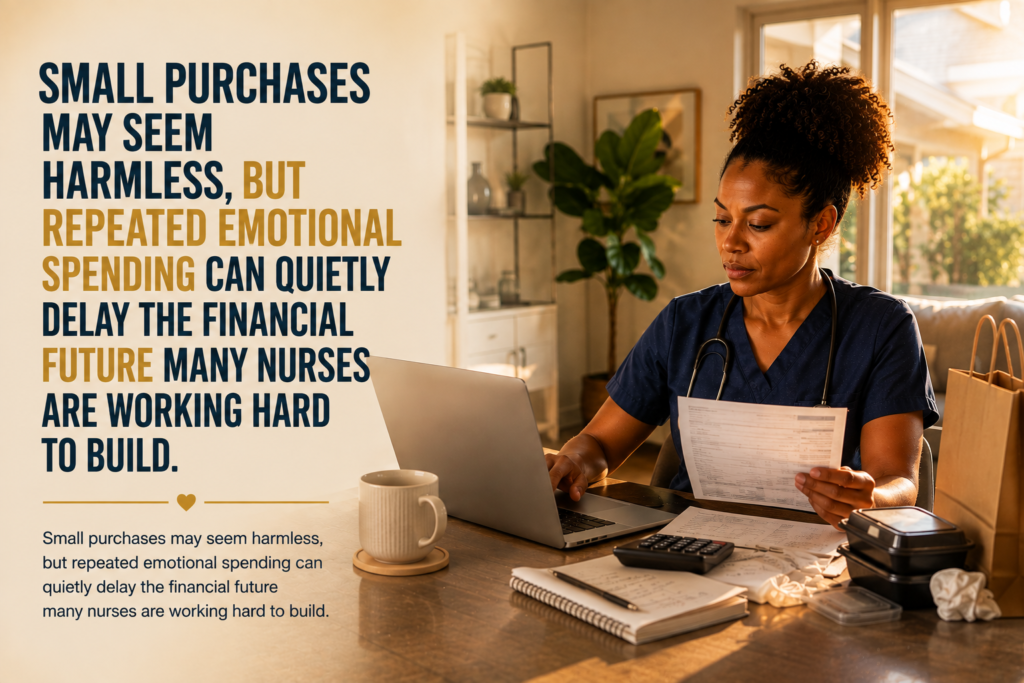
It often becomes a habit that quietly repeats itself after stressful days, exhausting weeks, or emotionally draining months. Because the individual purchases are usually small, many nurses don’t realize how much these habits are affecting their finances until they look back over several months of bank or credit card statements.
A $25 food delivery here.
A $60 online shopping order there.
Coffee every morning after night shift.
An impulse purchase during lunch.
A weekend shopping trip after working overtime.
Individually, none of these expenses seem significant.
Together, they can quietly consume hundreds—or even thousands—of dollars every year.
The financial impact isn’t just about the money you spend today. It’s also about the opportunities that money could have created if it had been used differently.
Small Purchases Can Delay Big Financial Goals
Many nurses dream about achieving financial milestones such as:
- Paying off student loans
- Buying their first home
- Building an emergency fund
- Traveling without financial stress
- Investing for retirement
- Becoming financially independent
Yet these goals often feel frustratingly out of reach.
While major expenses certainly play a role, recurring emotional spending can quietly slow progress month after month.
Imagine spending an average of:
- $20 on food delivery after two shifts each week
- $40 on impulse online purchases every weekend
- $7 on specialty coffee five mornings each week
Over a year, these seemingly harmless habits can add up to several thousand dollars.
That same money could have been used to reduce debt, build savings, or begin investing for the future.
This doesn’t mean you should never enjoy your income.
It means recognizing the difference between intentional spending that brings lasting value and automatic spending that temporarily eases emotional stress.
Emotional Spending Can Increase Financial Anxiety
Ironically, emotional spending often creates the very stress it’s trying to relieve.
After the temporary excitement wears off, many nurses begin thinking:
“I shouldn’t have bought that.”
“Why do I keep doing this?”
“I need to stop spending money.”
These thoughts often trigger guilt and frustration.
Financial anxiety grows.
Instead of feeling rewarded, you begin worrying about your credit card balance, upcoming bills, or whether you’ll have enough money left before your next paycheck.
The result is a cycle that feeds itself.
Stress leads to spending.
Spending leads to guilt.
Guilt creates financial anxiety.
Financial anxiety increases emotional stress.
Then another difficult shift happens—and the cycle begins again.
Without recognizing this pattern, many nurses mistakenly believe their problem is simply poor money management when the real issue is unresolved emotional exhaustion.
Credit Card Debt Can Grow Quietly
One of the biggest hidden costs of emotional spending is how easily it can transition from using cash to relying on credit.
When you’re tired, emotionally drained, or simply trying to get through another difficult week, using a credit card can feel easier than thinking about your budget.
Because the purchase doesn’t immediately affect your checking account, it often feels less significant in the moment.
Over time, however, balances begin to grow.
Interest charges accumulate.
Monthly payments increase.
What started as occasional convenience spending can gradually become long-term debt that takes years to eliminate.
For many nurses, this debt becomes another source of stress that follows them to work every day.
The Opportunity Cost of Emotional Spending
Every dollar you spend has more than one purpose.
It can provide immediate enjoyment today.
Or it can help create financial security tomorrow.
Financial experts often refer to this as opportunity cost—the value of what you give up when choosing one option over another.
For example, money spent on repeated impulse purchases cannot simultaneously be invested, saved for emergencies, or used to pay down high-interest debt.
This doesn’t mean every purchase should be analyzed or that you should never reward yourself.
It simply means becoming more intentional about where your money goes and whether those purchases truly support the life you’re trying to build.
Financial Freedom Is Built Through Small Decisions
Many people believe wealth is created through one big decision.
In reality, financial freedom is usually built through thousands of small choices repeated consistently over time.
Packing lunch instead of ordering delivery.
Waiting 24 hours before making an impulse purchase.
Creating a monthly comfort budget.
Automatically transferring money into savings after every paycheck.
Investing consistently, even if it’s only a small amount each month.
These habits may not feel exciting today.
But over the course of years, they can completely transform your financial future.
The goal isn’t perfection.
The goal is making more intentional decisions that align with both your emotional well-being and your long-term financial goals.
When you begin viewing every purchase as an opportunity to choose between temporary relief and lasting financial security, emotional spending gradually loses its power—and your confidence with money begins to grow.

How to Break the Cycle of Emotional Spending Without Giving Up the Things You Enjoy
Recognizing emotional spending is an important first step, but awareness alone doesn’t automatically change behavior.
Many nurses identify their spending triggers, promise themselves they’ll “do better next time,” and then find themselves making the same purchases after another stressful shift.
This isn’t because they lack discipline.
It’s because changing financial habits requires replacing old coping strategies with healthier ones—not simply eliminating them.
The goal is not to stop enjoying your money.
The goal is to spend intentionally instead of emotionally.
When you begin making purchases that align with your values and long-term financial goals, you can enjoy your income without the guilt that often follows emotional spending.
Identify Your Personal Spending Triggers
Every nurse has different triggers.
Some spend after emotionally difficult shifts.
Others spend after working overtime.
Some notice they shop online late at night when they can’t sleep after work.
Others spend more when they’re anxious, lonely, frustrated, or overwhelmed.
Spend a week paying attention to your emotions before making an unplanned purchase.
Ask yourself:
- What happened today?
- How am I feeling right now?
- Am I buying this because I need it—or because I need comfort?
- Will I still want this tomorrow?
- Is there another way I can meet this emotional need?
Simply asking these questions creates a pause between emotion and action.
That pause is often enough to prevent an impulse purchase.
Create a Post-Shift Recovery Routine
Many nurses spend money because they don’t have another recovery plan.
After giving everything to patients for twelve hours, your mind naturally searches for relief.
Instead of letting shopping become your automatic routine, intentionally create a recovery ritual that helps your body and mind decompress.
Your routine might include:
- Taking a warm shower.
- Drinking a cup of tea.
- Going for a short walk.
- Listening to calming music.
- Reading a book.
- Stretching for ten minutes.
- Journaling about your shift.
- Spending time with family or pets.
- Getting extra sleep before making financial decisions.
These activities won’t provide the instant excitement of clicking “Buy Now,” but they often deliver something much more valuable: genuine recovery.
Build a Monthly Comfort Budget
One of the biggest mistakes people make is believing they must eliminate all enjoyable spending.
That approach rarely lasts.
Instead, create a monthly comfort budget.
Set aside a specific amount of money each month for guilt-free purchases.
This could include:
- Coffee with friends.
- Takeout after an especially difficult shift.
- A massage.
- New books.
- Hobbies.
- Occasional online shopping.
- Self-care purchases.
Because you’ve planned for these expenses, you can enjoy them without worrying that you’re sabotaging your financial goals.
Intentional spending creates freedom.
Emotional spending creates stress.
Use the 24-Hour Rule
Impulse purchases thrive on urgency.
Retailers know this.
Limited-time offers.
Flash sales.
One-click checkout.
Free shipping.
These marketing tactics encourage immediate decisions.
Before making any unplanned purchase, commit to waiting 24 hours.
If you still want the item tomorrow—and it fits comfortably within your budget—you can buy it with confidence.
You’ll be surprised how many purchases lose their appeal after one day.
Make Saving Automatic
One of the easiest ways to reduce emotional spending is to remove the temptation before it begins.
Set up an automatic transfer every payday.
Even a small amount can make a difference.
When savings happen automatically, you’re less likely to spend money simply because it’s sitting in your checking account.
Over time, you’ll begin seeing your savings account grow instead of wondering where your paycheck disappeared.
Celebrate Progress Instead of Perfection
Breaking emotional spending habits doesn’t happen overnight.
Some weeks will be easier than others.
There will still be stressful shifts.
Unexpected expenses.
Moments when you buy something simply because you need a little comfort.
That’s okay.
Progress isn’t measured by never making another impulse purchase.
It’s measured by becoming more aware, making intentional decisions more often, and gradually building healthier financial habits.
Every thoughtful financial decision strengthens your confidence.
Every dollar saved moves you closer to financial freedom.
Every new habit proves that your relationship with money can change.
Give Yourself the Same Compassion You Give Your Patients
Nurses are often incredibly compassionate toward everyone except themselves.
You comfort patients during their hardest moments.
You reassure anxious families.
You encourage healing every single day.
You deserve that same compassion.
Instead of criticizing yourself for past financial decisions, acknowledge what you’ve learned.
Burnout may have influenced your spending habits, but it doesn’t have to define your financial future.
The goal isn’t becoming perfect with money.
The goal is creating a life where your financial decisions are guided by purpose rather than pressure.
When you replace guilt with self-awareness and small, consistent actions, you don’t just improve your finances—you build a healthier relationship with money that supports both your emotional well-being and your long-term goals.

The Hidden Financial Cost of Emotional Spending
By itself, buying takeout after a difficult shift or treating yourself to something nice doesn’t usually create financial problems.
The challenge is that emotional spending rarely happens just once.
It often becomes a habit that quietly repeats itself after stressful days, exhausting weeks, or emotionally draining months. Because the individual purchases are usually small, many nurses don’t realize how much these habits are affecting their finances until they look back over several months of bank or credit card statements.
A $25 food delivery here.
A $60 online shopping order there.
Coffee every morning after night shift.
An impulse purchase during lunch.
A weekend shopping trip after working overtime.
Individually, none of these expenses seem significant.
Together, they can quietly consume hundreds—or even thousands—of dollars every year.
The financial impact isn’t just about the money you spend today. It’s also about the opportunities that money could have created if it had been used differently.
Small Purchases Can Delay Big Financial Goals
Many nurses dream about achieving financial milestones such as:
- Paying off student loans
- Buying their first home
- Building an emergency fund
- Traveling without financial stress
- Investing for retirement
- Becoming financially independent
Yet these goals often feel frustratingly out of reach.
While major expenses certainly play a role, recurring emotional spending can quietly slow progress month after month.
Imagine spending an average of:
- $20 on food delivery after two shifts each week
- $40 on impulse online purchases every weekend
- $7 on specialty coffee five mornings each week
Over a year, these seemingly harmless habits can add up to several thousand dollars.
That same money could have been used to reduce debt, build savings, or begin investing for the future.
This doesn’t mean you should never enjoy your income.
It means recognizing the difference between intentional spending that brings lasting value and automatic spending that temporarily eases emotional stress.
Emotional Spending Can Increase Financial Anxiety
Ironically, emotional spending often creates the very stress it’s trying to relieve.
After the temporary excitement wears off, many nurses begin thinking:
“I shouldn’t have bought that.”
“Why do I keep doing this?”
“I need to stop spending money.”
These thoughts often trigger guilt and frustration.
Financial anxiety grows.
Instead of feeling rewarded, you begin worrying about your credit card balance, upcoming bills, or whether you’ll have enough money left before your next paycheck.
The result is a cycle that feeds itself.
Stress leads to spending.
Spending leads to guilt.
Guilt creates financial anxiety.
Financial anxiety increases emotional stress.
Then another difficult shift happens—and the cycle begins again.
Without recognizing this pattern, many nurses mistakenly believe their problem is simply poor money management when the real issue is unresolved emotional exhaustion.
Credit Card Debt Can Grow Quietly
One of the biggest hidden costs of emotional spending is how easily it can transition from using cash to relying on credit.
When you’re tired, emotionally drained, or simply trying to get through another difficult week, using a credit card can feel easier than thinking about your budget.
Because the purchase doesn’t immediately affect your checking account, it often feels less significant in the moment.
Over time, however, balances begin to grow.
Interest charges accumulate.
Monthly payments increase.
What started as occasional convenience spending can gradually become long-term debt that takes years to eliminate.
For many nurses, this debt becomes another source of stress that follows them to work every day.
The Opportunity Cost of Emotional Spending
Every dollar you spend has more than one purpose.
It can provide immediate enjoyment today.
Or it can help create financial security tomorrow.
Financial experts often refer to this as opportunity cost—the value of what you give up when choosing one option over another.
For example, money spent on repeated impulse purchases cannot simultaneously be invested, saved for emergencies, or used to pay down high-interest debt.
This doesn’t mean every purchase should be analyzed or that you should never reward yourself.
It simply means becoming more intentional about where your money goes and whether those purchases truly support the life you’re trying to build.
Financial Freedom Is Built Through Small Decisions
Many people believe wealth is created through one big decision.
In reality, financial freedom is usually built through thousands of small choices repeated consistently over time.
Packing lunch instead of ordering delivery.
Waiting 24 hours before making an impulse purchase.
Creating a monthly comfort budget.
Automatically transferring money into savings after every paycheck.
Investing consistently, even if it’s only a small amount each month.
These habits may not feel exciting today.
But over the course of years, they can completely transform your financial future.
The goal isn’t perfection.
The goal is making more intentional decisions that align with both your emotional well-being and your long-term financial goals.
When you begin viewing every purchase as an opportunity to choose between temporary relief and lasting financial security, emotional spending gradually loses its power—and your confidence with money begins to grow.

Conclusion
Burnout doesn’t just affect your energy, your mental health, or your ability to care for patients—it can also quietly influence the financial decisions you make every day.
If you’ve ever found yourself ordering takeout after a difficult shift, shopping online to unwind, or making impulse purchases simply because you were emotionally exhausted, know this: you’re not alone.
More importantly, you’re not “bad with money.”
Emotional spending for nurses is often a response to prolonged stress, compassion fatigue, decision fatigue, and burnout. Understanding that connection is the first step toward breaking the cycle.
Financial wellness isn’t about never buying yourself something nice or eliminating every enjoyable purchase from your life. It’s about becoming more intentional with your money and making financial decisions that support both your emotional well-being and your long-term goals.
Small changes can make a remarkable difference.
Preparing meals before your workweek.
Creating a realistic comfort budget.
Waiting 24 hours before making impulse purchases.
Building an emergency fund one paycheck at a time.
Investing consistently, even if you start with a small amount.
These habits may seem insignificant today, but over months and years they can transform your financial future.
Remember, financial freedom isn’t built through one perfect decision.
It’s built through thousands of intentional choices repeated consistently over time.
As a nurse, you’ve already demonstrated incredible resilience, compassion, and dedication throughout your career. Every day, you help patients navigate some of the most difficult moments of their lives.
Now it’s time to show yourself that same compassion.
Your past financial mistakes do not define your future.
Your burnout does not determine your financial destiny.
Every paycheck is a new opportunity.
Every budget is a fresh start.
Every intentional decision moves you one step closer to the life you’re working so hard to build.
Whether your goal is paying off debt, building an emergency fund, investing for retirement, or simply finding greater peace of mind with your finances, progress begins with one small decision today.
You deserve more than surviving from one shift to the next.
You deserve financial confidence, emotional peace, and the freedom to build a future that reflects the incredible work you do every day.
Start where you are.
Use what you have.
Keep moving forward.
One intentional decision at a time.
Frequently Asked Questions
Why is emotional spending so common among nurses?
Emotional spending for nurses is common because nursing is an emotionally and physically demanding profession. Long shifts, compassion fatigue, decision fatigue, understaffing, and chronic stress can lead many nurses to seek comfort through shopping, takeout, or other impulse purchases. While these purchases may provide temporary relief, they often don’t address the underlying emotional exhaustion driving the behavior.
Can burnout affect my financial decisions?
Yes. Burnout can influence how you make financial decisions by increasing emotional exhaustion, reducing self-control, and making immediate rewards feel more appealing than long-term financial goals. Many nurses find it harder to stick to a budget or avoid impulse purchases when they’re mentally and physically drained.
Is emotional spending the same as being bad with money?
No. Emotional spending is a coping behavior, not a measure of your financial intelligence. Many financially responsible people occasionally spend money in response to stress, anxiety, or burnout. Recognizing the pattern is the first step toward creating healthier financial habits.
How can I stop spending money after difficult nursing shifts?
Start by identifying your spending triggers and creating a post-shift recovery routine that doesn’t involve shopping. Activities like taking a walk, reading, journaling, exercising, or spending time with loved ones can provide emotional relief without negatively affecting your finances. Creating a monthly comfort budget can also help you enjoy your income without guilt.
What are the warning signs of emotional spending?
Common signs include:
- Frequently ordering takeout after work.
- Shopping online to relieve stress.
- Buying items you didn’t plan to purchase.
- Feeling guilty after spending money.
- Hiding purchases from family members.
- Using shopping as your primary way to cope with difficult emotions.
If these behaviors become frequent, it may be time to evaluate your spending habits more closely.
Can emotional spending lead to debt?
Yes. While occasional impulse purchases may not cause financial problems, repeated emotional spending can gradually increase credit card balances, reduce savings, and delay important financial goals. Over time, these habits can contribute to financial stress and make it more difficult to build long-term wealth.
Should I stop rewarding myself completely?
No. Healthy financial habits don’t require eliminating every enjoyable purchase. Instead, plan for enjoyable spending by creating a realistic comfort budget. Intentional rewards that fit within your budget are far more sustainable than unplanned emotional spending.
What is the first step toward changing emotional spending habits?
The first step is awareness. Before making an unplanned purchase, pause and ask yourself why you want to buy the item. Understanding whether you’re responding to a genuine need or an emotional trigger can help you make more intentional financial decisions
Can improving my financial habits reduce stress?
Yes. Building healthier financial habits, paying down debt, creating an emergency fund, and saving consistently can reduce financial anxiety over time. While money won’t eliminate workplace stress, improving your financial confidence can help you feel more prepared and in control.
Can nurses achieve financial freedom after struggling with emotional spending?
Absolutely. Emotional spending does not define your financial future. With awareness, consistent budgeting, intentional spending, and long-term financial planning, nurses can break the cycle of emotional spending and build lasting financial security.
Disclaimer
Disclaimer: The information provided in this article is for educational and informational purposes only and should not be considered financial, investment, legal, or mental health advice. Every individual’s financial situation is unique. Before making significant financial decisions, consult a qualified financial professional. If emotional spending is connected to chronic stress, anxiety, depression, or burnout, consider seeking support from a licensed mental health professional.