
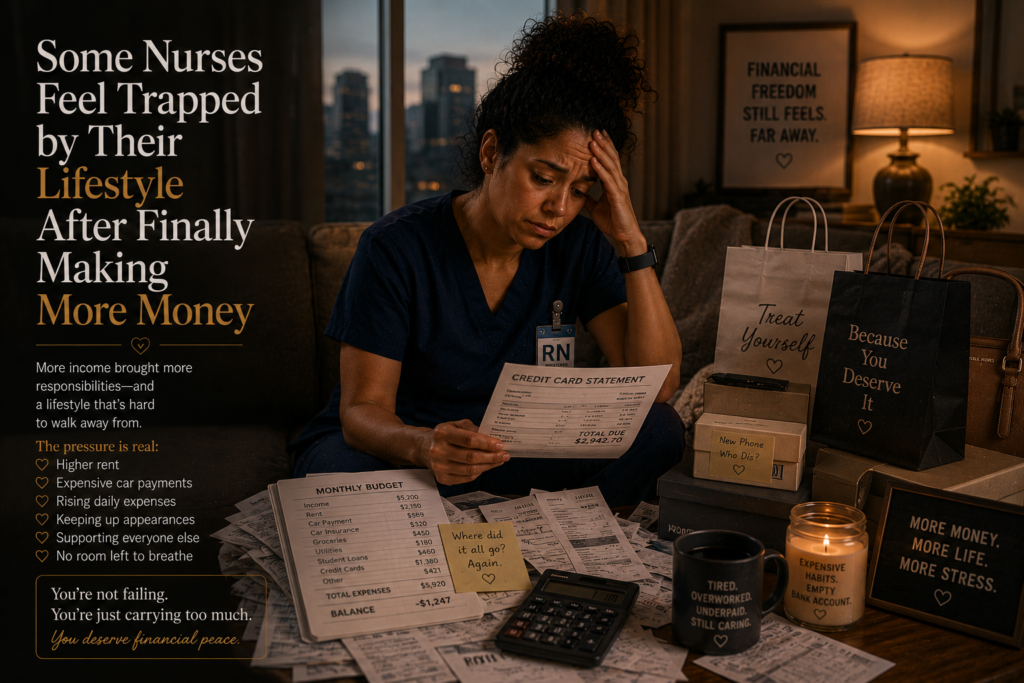
Many nurses feel trapped by lifestyle inflation after finally earning more money. While higher income can improve financial stability, nurses feel trapped by lifestyle inflation, in which spending increases alongside income, making it difficult to build wealth or achieve financial freedom. Many nurses believed financial stress would finally disappear once they started making more money.
After years of:
- nursing school
- debt
- financial struggle
- exhaustion
- sacrifice
earning a nursing income often felt like the beginning of financial stability.
But for some nurses, increasing income also quietly increased:
- monthly expenses
- financial obligations
- lifestyle expectations
- emotional spending
- overtime dependency
- pressure to maintain appearances
And over time, many nurses begin realizing they are earning more money — while still feeling financially trapped emotionally.

Making More Money Does Not Automatically Remove Financial Stress
Many nurses expected their financial anxiety to disappear once they finally started earning a stable income. After years of nursing school, long shifts, career advancement, and professional growth, it seems reasonable to assume that a larger paycheck would automatically create greater financial peace.
For many nurses, however, the reality is often far more complicated.
Financial stress does not always disappear when income increases. In some cases, it simply changes form.
As earnings grow, financial responsibilities often grow as well. What initially feels like financial progress can slowly become a new set of expectations, obligations, and expenses that consume much of the additional income.
Some nurses gradually take on:
- Higher rent or larger mortgage payments
- Newer vehicles with larger monthly payments
- Increased insurance costs
- Family financial responsibilities
- Lifestyle upgrades
- Subscription services
- More frequent dining out
- Travel and vacation expenses
- Higher household costs
- Increased spending expectations
Most of these decisions are not reckless or irresponsible. In fact, many lifestyle improvements feel completely justified after years of hard work and sacrifice.
The challenge is that these expenses often increase gradually.
A slightly larger car payment here.
A more expensive apartment there.
Additional monthly subscriptions.
A few convenience purchases each week.
More frequent spending because income appears more comfortable.
Individually, these changes may seem small. However, over months and years, they can significantly reduce the financial benefits of higher earnings.
This is one of the primary reasons many nurses feel trapped by lifestyle inflation.
As income increases, spending often increases at a similar pace. Instead of creating additional savings, reducing debt, or building investments, much of the new income becomes committed to maintaining a more expensive lifestyle.
For some nurses, this creates an emotionally exhausting cycle.
They work harder.
They earn more money.
They take on additional responsibilities.
Yet they still feel financially stressed.
The financial freedom they expected never fully arrives.
Many nurses describe feeling confused by this experience. They remember earning much less earlier in their careers and believing that a certain income level would solve most of their financial problems. Once they finally reach that income level, they often discover that their financial worries have not disappeared.
The numbers may have changed, but the stress remains.
This can create frustration, disappointment, and self-doubt. Some nurses begin questioning their financial decisions or wondering why they still feel behind despite working so hard.
The truth is that financial peace rarely comes from income alone.
Financial stability is often created through a combination of income, spending habits, financial planning, debt management, saving, investhttps://www.investor.gov/introduction-investing?utm_source=chatgpt.coming, and long-term wealth-building strategies.
Making more money is valuable. However, earning more money without intentionally managing lifestyle inflation can make it surprisingly difficult to achieve the financial freedom many nurses are seeking.
Understanding this reality is not about avoiding success or never enjoying your income. It is about recognizing that higher earnings alone do not guarantee financial security. True financial progress occurs when increased income is paired with intentional financial habits that support long-term stability, wealth building, and financial freedom.

Lifestyle Inflation Can Quietly Increase Emotional Pressure
For many nurses, lifestyle inflation happens gradually. Unlike a major financial mistake, lifestyle inflation rarely appears overnight. Instead, it often develops through a series of small decisions that seem reasonable, responsible, and even deserved after years of hard work.
The changes often feel completely justified at first.
Many nurses begin:
- Upgrading apartments or purchasing larger homes
- Buying newer vehicles
- Helping family members financially
- Spending more after years of financial struggle
- Rewarding themselves after burnout
- Taking more vacations
- Increasing convenience spending
- Purchasing items they previously could not afford
- Improving their overall quality of life
None of these choices are inherently wrong.
In fact, many nurses have spent years sacrificing personal comfort while completing nursing school, working demanding shifts, paying down debt, and building their careers. It is natural to want to enjoy the benefits of increased income.
The challenge arises when these lifestyle upgrades become permanent financial obligations.
A larger mortgage payment becomes a monthly commitment.
A newer vehicle comes with ongoing payments, insurance costs, fuel expenses, and maintenance.
Additional subscriptions quietly accumulate.
Dining out becomes a regular habit rather than an occasional treat.
Over time, these higher monthly expenses can slowly absorb income that could have been used for savings, investing, debt reduction, or building long-term wealth.
As expenses increase, so does the pressure to maintain the lifestyle that has been created.
Many nurses eventually find themselves feeling emotionally trapped between competing priorities:
- Maintaining their current lifestyle
- Working overtime to support increased expenses
- Trying to reduce stress and burnout
- Wanting greater financial freedom
- Building savings and investments
- Avoiding financial setbacks
- Supporting family responsibilities
- Creating a more secure future
This emotional conflict can become exhausting.
On one hand, nurses want to enjoy the rewards of their hard work. On the other hand, they may begin realizing that their lifestyle now requires them to continue working at an intense pace simply to maintain it.
The result is often a subtle but persistent form of financial anxiety.
Many nurses begin feeling that they cannot slow down.
They cannot reduce overtime.
They cannot take extended time off.
They cannot easily change jobs or pursue different opportunities.
Their financial obligations make them feel locked into a cycle of constant work and constant responsibility.
Over time, this pressure can affect emotional well-being in ways that are not immediately obvious. Financial concerns may follow nurses throughout the day, making it difficult to fully relax, recover from burnout, or enjoy the lifestyle they worked so hard to create.
Ironically, the very lifestyle upgrades that were intended to create happiness can sometimes become a source of ongoing stress.
This is one reason lifestyle inflation can be so challenging to recognize. The issue is not necessarily the purchases themselves. The issue is the growing gap between financial freedom and financial obligation.
True financial freedom is not simply about earning more money. It is about creating a lifestyle that allows flexibility, peace of mind, and the ability to make choices without feeling controlled by financial commitments.
When nurses become aware of lifestyle inflation, they gain the opportunity to make more intentional decisions about spending, saving, investing, and long-term financial planning. Small adjustments made over time can reduce financial pressure and help create a lifestyle that supports both financial success and emotional well-being.

Real Nurse Scenario: Making More Money but Still Feeling Stressed
Jasmine worked incredibly hard to become a nurse because she believed financial stability would finally feel easier once she started earning a higher income. Like many nurses, she spent years looking forward to the day when financial stress would no longer dominate her life.
Nursing school was difficult.
Money was tight.
Every expense required careful planning.
Every paycheck seemed to disappear immediately.
During those years, Jasmine often told herself that things would improve once she became a nurse and started earning more money.
At first, that prediction seemed accurate.
Receiving a larger paycheck felt exciting.
For the first time in years, she felt like she had room to breathe financially.
She upgraded her apartment.
Bought a newer vehicle.
Started helping family members more financially.
Spent more freely after years of financial struggle.
Enjoyed experiences she previously could not afford.
And for a while, those changes felt rewarding.
After all, she had worked hard to reach this point.
The problem was not any single purchase.
The problem was that her monthly expenses quietly grew alongside her income.
As her lifestyle improved, so did her financial obligations.
Rent increased.
Car payments increased.
Insurance costs increased.
Spending habits changed.
Family expectations grew.
Monthly expenses gradually became larger and more difficult to reduce.
At first, Jasmine barely noticed the changes.
Everything seemed manageable.
But over time, something unexpected happened.
Despite earning more money than she ever had before, she still felt:
- Financially anxious
- Dependent on overtime
- Stressed about monthly bills
- Emotionally exhausted
- Concerned about unexpected expenses
- Frustrated by a lack of savings
- Afraid of financial setbacks
- Uncertain about her long-term financial future
The realization felt emotionally frustrating.
She had spent years believing that a larger income would automatically create financial peace. Yet despite achieving the income level she once dreamed about, she still felt stressed about money.
She found herself picking up overtime shifts to maintain her lifestyle.
She worried about emergencies affecting her finances.
She struggled to save as much as she thought she should.
She questioned why financial freedom still felt so far away.
What Jasmine eventually discovered is something many nurses experience.
Income and financial security are not always the same thing.
A higher salary can improve financial opportunities, but if expenses continue growing alongside income, financial stress can remain surprisingly similar.
This is one of the clearest examples of lifestyle inflation.
As earnings increase, spending often increases as well. Without intentional financial planning, budgeting, saving, investing, and debt reduction strategies, additional income may create a more expensive lifestyle without creating greater financial freedom.
Jasmine’s story is not unusual.
Many nurses appear financially successful on the outside while privately carrying significant financial stress. They may own newer vehicles, live in nicer homes, and earn higher incomes, yet still feel trapped by ongoing financial obligations and constant pressure to keep earning more.
The encouraging news is that awareness creates opportunity.
Once Jasmine recognized how lifestyle inflation was affecting her finances, she began making more intentional decisions. Instead of focusing solely on increasing income, she started focusing on building savings, reducing unnecessary expenses, strengthening her financial habits, and creating long-term financial goals.
Her financial situation did not change overnight, but her mindset did.
And that shift became the first step toward creating genuine financial stability rather than simply maintaining a more expensive lifestyle.al stress would finally disappear by now.

Financial Peace Requires More Than a Higher Income
Many nurses eventually realize that financial peace is not only about earning more money. While a higher income can certainly create new opportunities and reduce certain financial struggles, it does not automatically eliminate financial anxiety, emotional stress, or the pressure that comes from feeling financially responsible for everything and everyone.
This realization can be surprising.
Many nurses spend years believing that a specific income level will finally make life feel easier. They tell themselves that once they earn a little more, pay off a certain debt, or reach a particular salary, financial stress will disappear.
But for many healthcare professionals, that moment never arrives exactly as expected.
Instead, they discover that financial peace is influenced by much more than income alone.
True financial well-being often requires:
- Emotional security
- Healthier financial habits
- Reduced chronic stress
- Lower financial pressure
- Realistic lifestyle expectations
- Emergency savings
- Financial lithttps://www.consumerfinance.gov/consumer-tools/educator-tools/adult-financial-education/?utm_source=chatgpt.comeracy
- Long-term financial planning
- Wealth-building strategies
- Nervous system recovery
Without these foundations, higher income alone may not fully remove financial anxiety.
Many nurses continue earning more money while still worrying about bills, unexpected expenses, debt, retirement planning, or maintaining an increasingly expensive lifestyle. Even when income grows, the emotional weight of financial responsibility can remain.
One reason this happens is because financial stress is not always a numbers problem.
Often, it becomes an emotional problem as well.
When someone spends years worrying about money, carrying financial obligations, and operating under constant pressure, the nervous system can become accustomed to stress. Even when financial circumstances improve, the body and mind may continue responding as if danger is still present.
This is why some nurses continue feeling anxious about money despite earning more than they ever have before.
They may have a better income.
They may have a nicer home.
They may have more financial resources.
Yet they still struggle to feel truly secure.
Over time, this emotional tension can quietly contribute to burnout, fatigue, and ongoing dissatisfaction.
Many nurses begin living in a cycle where increased income is immediately absorbed by increased expenses. The solution then becomes working more overtime, accepting additional responsibilities, or finding new ways to earn money.
While these strategies can provide temporary relief, they often fail to address the deeper issue: creating a financial life that feels sustainable and emotionally healthy.
Financial peace comes from knowing that you have options.
It comes from feeling confident in your financial decisions.
It comes from having savings for emergencies.
It comes from reducing unnecessary financial pressure.
It comes from building habits that support long-term financial freedom rather than short-term financial survival.
Most importantly, financial peace comes from reaching a point where your life is no longer controlled by constant financial fear.
When nurses begin focusing on both financial health and emotional well-being, they often discover that true financial stability is not measured solely by income. It is measured by the ability to enjoy life, recover from stress, make choices with confidence, and look toward the future without feeling trapped by money concerns.
Higher income can be an important part of that journey, but lasting financial peace is usually built through intentional financial habits, realistic expectations, emotional resilience, and a commitment to creating a healthier relationship with money over time.

Financial Stability Feels Different Than Financial Appearance
Many nurses work incredibly hard to improve their financial situation. They spend years building their careers, working long shifts, earning certifications, picking up overtime, and making sacrifices in the hope that one day life will feel more financially secure.
After years of hard work, it makes complete sense why many nurses want to finally enjoy the rewards of earning more money.
For some, that means upgrading their home.
For others, it means purchasing a newer vehicle, traveling more often, helping family members financially, or enjoying experiences they previously could not afford.
There is nothing wrong with wanting to enjoy the benefits of success.
The challenge occurs when financial appearance begins to replace financial stability.
From the outside, a person may appear financially successful. They may drive a newer vehicle, live in a nicer neighborhood, wear professional clothing, and earn a respectable income. Yet privately, they may still feel stressed about bills, dependent on overtime, worried about debt, and uncertain about their financial future.
This is why financial stability feels very different than financial appearance.
Financial appearance focuses on what others can see.
Financial stability focuses on what allows a person to feel secure when nobody is watching.
True financial stability often includes:
- Healthier financial boundaries
- Reduced overtime dependency
- Lower chronic financial stress
- Emergency savings
- Debt reduction
- Emotional recovery
- Intentional spending habits
- Financial breathing room
- Long-term investing
- Retirement planning
- Nervous system stability
- Greater financial confidence
Many nurses discover that financial peace does not come from appearing successful. It comes from feeling secure.
Feeling secure means knowing an unexpected expense will not create a crisis.
Feeling secure means being able to take a day off without financial guilt.
Feeling secure means having options rather than feeling trapped by financial obligations.
Feeling secure means building a lifestyle that supports both financial health and emotional well-being.
One of the hidden dangers of lifestyle inflation is that it can create the appearance of progress without always creating genuine financial freedom. Income may increase. Lifestyle may improve. Yet the underlying stress remains because expenses continue expanding alongside earnings.
Over time, this can leave many nurses feeling trapped between maintaining their lifestyle and achieving true financial stability.
The goal is not guilt around enjoying life.
The goal is not pretending nurses should never spend money on themselves.
And the goal is certainly not avoiding the rewards that come from years of hard work and dedication.
Instead, the goal is balance.
The goal is creating a lifestyle that feels emotionally sustainable, financially healthy, and aligned with long-term goals.
The goal is creating enough financial breathing room that life does not feel controlled by constant pressure, overtime dependency, or fear of falling behind.
When nurses begin prioritizing financial stability over financial appearance, many discover something surprisingly valuable: peace of mind.
Peace of mind cannot be purchased through lifestyle upgrades alone.
It is often built through intentional financial decisions, healthy money habits, realistic expectations, and a commitment to creating a life that feels sustainable beneath the surface.
Nurses spend their careers helping others heal and recover. They deserve financial lives that feel calmer than constant pressure, more secure than constant survival mode, and more fulfilling than simply keeping up appearances.
Over time, the strongest form of financial success is not what other people see. It is the ability to live with confidence, flexibility, and the peace that comes from knowing your financial foundation is strong.
Conclusion
Many nurses spend years working toward higher income because they believe earning more money will finally create the financial peace they have been searching for.
And while higher income can absolutely improve opportunities, lifestyle inflation often teaches a difficult lesson: earning more money and feeling financially secure are not always the same thing.
For many nurses, lifestyle inflation happens slowly. A larger apartment, a newer vehicle, increased spending, family financial responsibilities, and everyday lifestyle upgrades can quietly consume income that once felt like financial progress.
Over time, this can create an exhausting cycle where income continues increasing, but financial freedom never seems to arrive.
Many nurses eventually discover that the problem is not a lack of income. The problem is that expenses often rise alongside earnings, leaving little room for savings, investing, debt reduction, or long-term wealth building.
As a result, some nurses feel trapped between maintaining their lifestyle and creating the financial future they truly want.
The encouraging news is that financial awareness creates opportunity.
Once nurses recognize the impact of lifestyle inflation, they can begin making more intentional decisions about spending, saving, investing, and long-term financial planning. Small changes made consistently over time can create significant improvements in both financial stability and emotional well-being.
The goal is not to feel guilty about enjoying the rewards of hard work.
The goal is not to avoid spending money on things that improve quality of life.
And the goal is certainly not to pretend nurses should never enjoy financial success.
Instead, the goal is balance.
The goal is creating a lifestyle that supports both happiness today and financial security tomorrow.
True financial freedom is not measured by the size of a paycheck, the model of a vehicle, or the appearance of success. It is measured by peace of mind, financial flexibility, reduced stress, and the ability to make life decisions without constantly feeling pressured by money.
Nurses spend their careers helping others improve their lives. They deserve financial lives that feel stable, sustainable, and rewarding as well.
With intentional financial habits, realistic lifestyle expectations, and a commitment to long-term financial growth, it is possible to enjoy the benefits of increased income without becoming trapped by lifestyle inflation.

Frequently Asked Questions
What is lifestyle inflation?
Lifestyle inflation happens when spending increases alongside income. As people earn more money, they often begin spending more on housing, vehicles, dining, travel, subscriptions, and other lifestyle upgrades. While these changes may feel rewarding, lifestyle inflation can make it difficult to build savings, reduce debt, invest consistently, or achieve long-term financial freedom despite earning a higher income.
Why do some nurses still feel financially stressed despite earning more?
Many nurses expect financial stress to disappear once they reach a certain income level. However, higher income often comes with increased financial obligations, family responsibilities, lifestyle upgrades, and growing monthly expenses. As a result, some nurses continue feeling financially stretched even while earning significantly more than they did earlier in their careers.
How does lifestyle inflation affect financial freedom?
Lifestyle inflation can reduce the amount of money available for wealth building, retirement planning, investing, emergency savings, and debt reduction. When expenses rise at the same pace as income, financial progress may feel slower than expected. Over time, this can delay financial goals and make financial freedom feel more difficult to achieve.
Can higher income alone remove financial anxiety?
Not always. While earning more money can certainly improve financial opportunities, financial peace often depends on more than income alone. Emotional security, healthy financial habits, emergency savings, financial literacy, intentional spending, and reduced chronic stress all play important roles in long-term financial well-being.
What are common signs of lifestyle inflation?
Common signs of lifestyle inflation include increasing monthly expenses after receiving raises, relying on overtime to maintain a lifestyle, upgrading vehicles or housing frequently, struggling to build savings despite earning more money, and feeling financially stressed even as income continues to grow.
How can nurses avoid lifestyle inflation?
Nurses can reduce the impact of lifestyle inflation by creating a budget, setting financial goals, building emergency savings, paying down debt, investing consistently, and carefully evaluating major purchases before increasing monthly obligations. Small financial decisions made consistently over time can create significant long-term benefits.
Can financial habits improve gradually?
Yes. Financial improvement rarely happens overnight. Many nurses slowly build healthier financial systems, stronger money manag https://consumer.gov/your-money?utm_source=chatgpt.comement habits, improved financial literacy, and greater financial stability through consistent action over time. Small changes made regularly often create meaningful long-term progress.
Is it wrong to enjoy the benefits of earning more money?
Absolutely not. The goal is not to avoid enjoying life or feeling guilty about financial success. The goal is to enjoy increased income intentionally while still protecting long-term financial stability. Many nurses successfully balance lifestyle enjoyment with saving, investing, and wealth building by creating thoughtful financial plans.
What is the difference between financial appearance and financial stability?
Financial appearance focuses on what others can see, such as homes, vehicles, vacations, and material possessions. Financial stability focuses on what creates genuine security, including savings, reduced debt, financial flexibility, emergency funds, and confidence about the future. Long-term financial peace is usually built through stability rather than appearance.