

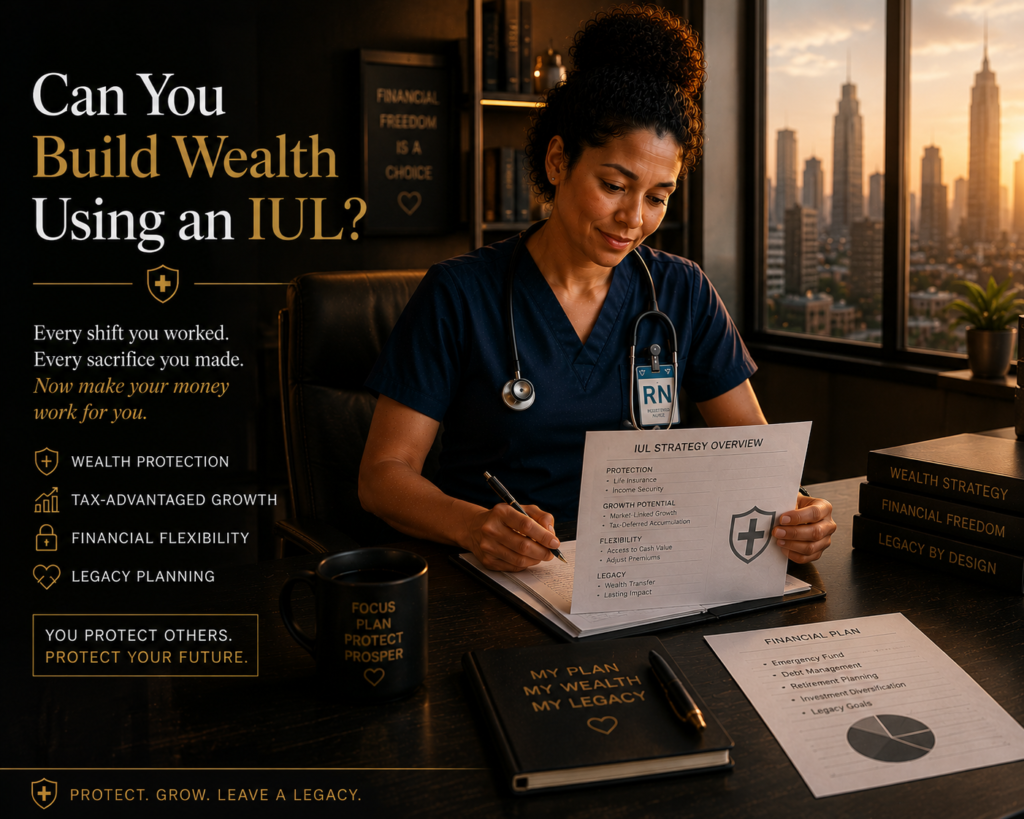
Many nurses work incredibly hard to earn strong incomes.
But over time, many also begin realizing that earning money and building lasting wealth are not always the same thing.
Taxes.
Debt.
Burnout spending.
Lifestyle inflation.
Financial stress.
Lack of long-term strategy.
All of these things can quietly slow wealth building — even for high earners.
That is one reason more nurses, business owners, and higher-income professionals have started exploring strategies focused on:
- long-term protection
- tax diversification
- cash value accumulation
- legacy planning
- financial flexibility
And one financial tool that often enters those conversations is Indexed Universal Life Insurance — commonly called an IUL.
But despite how heavily IULs are marketed online, many people still do not fully understand:
- how they work
- how wealth building inside an IUL actually happens
- who they may help
- who they may NOT be appropriate for
- and why proper policy design matters so much
What Is an Indexed Universal Life Insurance (IUL) Policy?
An Indexed Universal Life Insurance policy — often called an IUL — is a type of permanent life insurance designed to combine:
- long-term protection
- cash value accumulation
- and financial flexibility
Like traditional life insurance, an IUL includes a death benefit designed to help financially protect loved ones if something happens to the insured person.
But unlike basic term insurance, an IUL may also build cash value over time.
That cash value growth is typically linked to the performance of a market index such as the S&P 500 — without directly investing the policyholder’s money into the stock market itself.
That distinction matters.
The insurance company credits interest based on index performance according to specific policy rules, which may include:
- participation rates
- caps
- spreads
- floors
Many policies include a floor of 0%, which means a negative market year may result in no credited interest from index performance — but not a direct market loss credited from the index itself.
How an IUL Builds Cash Value Over Time
When premiums are paid into an IUL policy, portions of the money may go toward:
- insurance costs
- administrative expenses
- policy charges
- cash value accumulation
Over time, the policy’s cash value may grow and potentially become an additional financial resource.
Depending on policy structure and performance, some policyholders later use cash value for:
- supplemental retirement income
- business opportunities
- emergency liquidity
- tax diversification strategies
- legacy planning
- long-term financial flexibility
But like any financial strategy, long-term outcomes depend heavily on:
- policy design
- funding levels
- time horizon
- fees
- and how the policy is managed over time.
Why Higher-Income Professionals Often Explore IUL Strategies
Many higher-income professionals eventually realize that building wealth involves more than simply earning good money.
Over time, taxes, lifestyle inflation, market volatility, debt, and lack of long-term planning can quietly reduce wealth-building progress.
That is one reason some professionals begin exploring strategies focused on:
- tax diversification
- long-term protection
- liquidity access
- retirement flexibility
- legacy planning
- wealth preservation
For some nurses, physicians, business owners, and entrepreneurs, an IUL becomes attractive because it may offer:
- permanent life insurance protection
- tax-deferred cash value growth
- potential policy loan access
- downside protection features
- long-term financial flexibility
But like any financial tool, the value of an IUL depends heavily on:
- proper structure
- long-term funding
- realistic expectations
- and whether it fits the person’s overall financial strategy.

The Biggest Misunderstanding About IUL Wealth Building
One of the biggest misconceptions online is the idea that an IUL is a shortcut to instant wealth.
It is not.
In reality, many IUL policies require:
- long-term funding
- patience
- proper structure
- realistic expectations
- and time for cash value accumulation
Early policy years may include:
- insurance charges
- administrative costs
- surrender periods
- slower early cash value growth
That is why an IUL is usually better understood as a long-term financial strategy — not a quick investment shortcut.
And for many people, whether an IUL makes sense depends entirely on their:
- goals
- income
- debt situation
- protection needs
- and overall financial foundation.
Common Mistakes People Make With IUL Policies
Like many financial products, the effectiveness of an IUL often depends more on how the policy is designed and funded than the product name itself.
Some common mistakes people make include:
- underfunding the policy
- expecting short-term results
- not understanding policy charges
- buying based only on marketing hype
- focusing only on illustrations instead of long-term strategy
- working with someone focused only on selling the policy rather than designing it properly
And because every insurance company structures policies differently, understanding the details matters significantly.
Long-term wealth strategies usually require:
- realistic expectations
- proper education
- strong financial foundations
- and long-term consistency

Who Might Benefit From an IUL — And Who May Need Different Priorities First
An IUL may appeal to people who:
- earn stable income
- want long-term protection
- value tax diversification
- think long-term financially
- own businesses
- want legacy planning strategies
- seek additional financial flexibility
But an IUL may not always be the first financial priority for everyone.
Some people may first need to focus on:
- emergency savings
- high-interest debt reduction
- basic life insurance protection
- cash flow stability
- financial recovery from chronic stress
In many cases, strong financial foundations should come before more advanced wealth-planning strategies.
Wealth Building Is About More Than Just Income
Many nurses and higher-income professionals spend years focusing almost entirely on earning more money.
But eventually, many begin realizing that long-term financial security also involves:
- protection
- tax strategy
- liquidity
- legacy planning
- emotional financial stability
- intentional long-term systems
An IUL is not a magic shortcut to wealth.
And it is not the right solution for every financial situation.
But when properly structured and aligned with someone’s long-term goals, it may become one piece of a broader financial strategy focused on:
- protection
- flexibility
- wealth preservation
- and long-term planning
Because true wealth is not simply about income.
It is also about creating:
- financial resilience
- family protection
- long-term options
- reduced financial vulnerability
- and greater peace of mind over time.
For many nurses, financial transformation begins when money is no longer viewed only through the lens of survival — but through the lens of long-term stability and legacy as well.

Explore Wealth Strategies More Intentionally
At Nurse Money Lab, the mission is not simply helping nurses earn more money.
It is helping nurses:
- build long-term wealth
- reduce financial stress
- understand advanced financial strategies
- protect income and family
- create healthier financial systems
- move beyond survival mode financially
- build lasting financial confidence
Because financial peace should include both protection and possibility.
Frequently Asked Questions
Can an IUL help build wealth?
An Indexed Universal Life policy may help build cash value over time when properly structured, funded consistently, and used as part of a broader long-term financial strategy.
Is an IUL the same as investing directly in the stock market?
No. IUL cash value growth is generally linked to market index performance without directly investing policyholder funds into the stock market itself.
Who may benefit most from an IUL?
Higher-income professionals, business owners, and long-term planners seeking protection, tax diversification, liquidity access, and legacy planning may explore IUL strategies.
Are IULs good for short-term wealth building?
Typically no. IULs are generally designed as long-term financial strategies rather than short-term investment vehicles.