
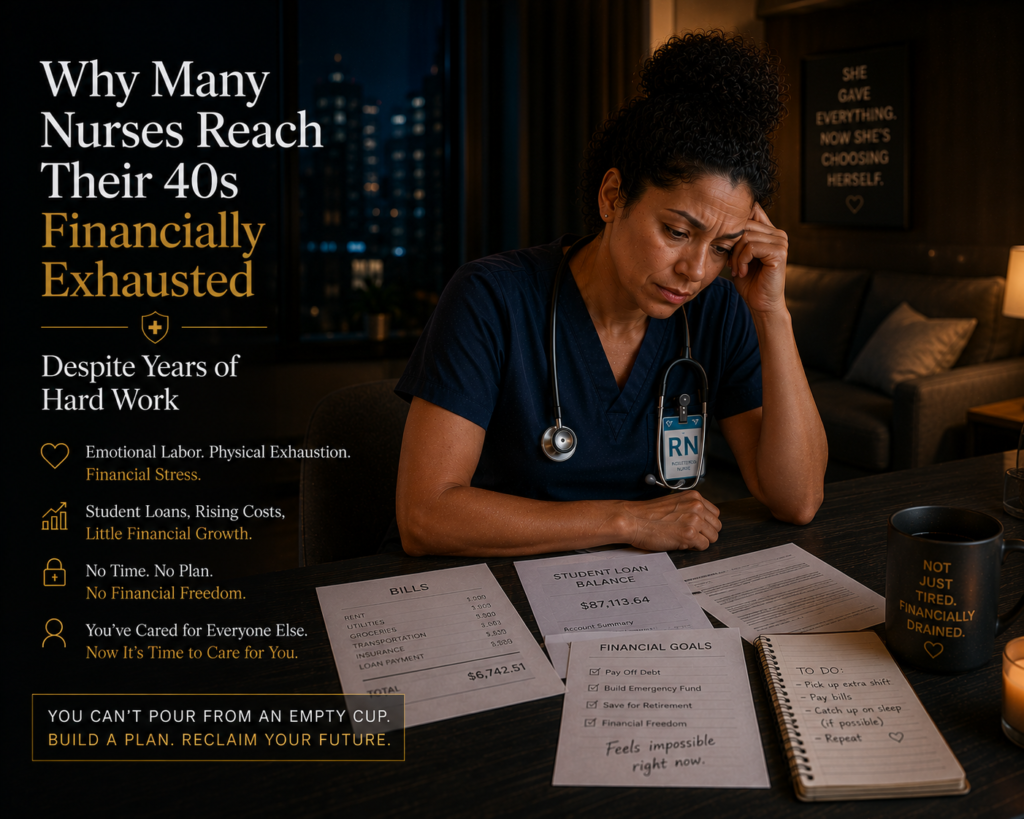
Many nurses reach their 40s financially exhausted despite spending decades caring for patients, working overtime, supporting families, and trying to build financial security.
Many nurses reach their 40s financially exhausted not because they failed financially, but because years of burnout, debt, rising living costs, survival mode, and delayed long-term planning quietly accumulate over time.
While nursing can provide a stable income, income alone does not automatically create financial freedom or lasting wealth. This article explores why nurses reach their 40s financially exhausted, the hidden factors contributing to financial exhaustion, and practical steps for creating greater financial stability, retirement readiness, and peace of mind.
More shifts.
More overtime.
More sacrifice.
More emotional exhaustion.
And for a while, pushing harder may appear to work financially.
But over time, many nurses quietly reach their late 30s or 40s feeling:
- emotionally burned out
- financially overwhelmed
- behind on retirement
- exhausted from constant responsibility
- anxious about the future
- unsure how long they can continue living this way
Some nurses spent years surviving financially without ever having enough time, energy, or financial education to build long-term wealth intentionally.
And eventually, many begin realizing that working hard alone does not automatically create financial peace.

Years of Survival Mode Quietly Change Financial and Emotional Health
Many nurses spend years operating in nonstop survival mode financially.
During certain seasons of life, survival mode may feel necessary.
There are bills to pay.
Children to support.
Debt to manage.
Emergencies to survive.
Patients to care for.
And because nursing often requires enormous emotional, mental, and physical energy, many nurses spend years simply trying to make it through one exhausting season at a time.
At first, survival mode feels temporary.
Many nurses tell themselves:
“Once I pay off this debt, things will get easier.”
“Once the kids are older, I’ll focus on my finances.”
“Once I get through this stressful assignment, I’ll start planning for the future.”
But life rarely slows down completely.
New expenses appear.
Unexpected emergencies happen.
Family responsibilities grow.
Healthcare costs rise.
Financial pressure continues.
And before many nurses realize it, years have passed.
Over decades, chronic stress can quietly affect:
- Financial decisions
- Emotional recovery
- Long-term planning
- Savings consistency
- Retirement preparation
- Mental health
- Nervous system regulation
- Financial confidence
- Wealth-building habits
- Overall quality of life
One of the hidden dangers of long-term survival mode is that it often shifts attention away from the future and toward immediate needs.
Instead of asking:
“How can I build wealth?”
Many nurses find themselves asking:
“How can I get through this month?”
Instead of focusing on retirement planning, investing, and financial freedom, their attention remains centered on bills, overtime, debt, and daily responsibilities.
This is not a sign of failure.
It is often a natural response to prolonged financial stress.
When the brain and nervous system remain focused on survival, long-term planning becomes more difficult.
Many nurses eventually realize they spent years working hard without creating the financial systems needed to support lasting stability.
The result can be emotionally painful.
After decades of caring for others, sacrificing personal time, and working countless shifts, some nurses reach their 40s wondering why financial security still feels so far away.
The encouraging news is that awareness creates opportunity.
Recognizing the effects of long-term survival mode is often the first step toward changing direction.
Financial recovery, wealth building, and greater financial confidence can begin at any stage of life.
The goal is not to regret the past.
The goal is to use the lessons learned to create a stronger financial future moving forward.y.
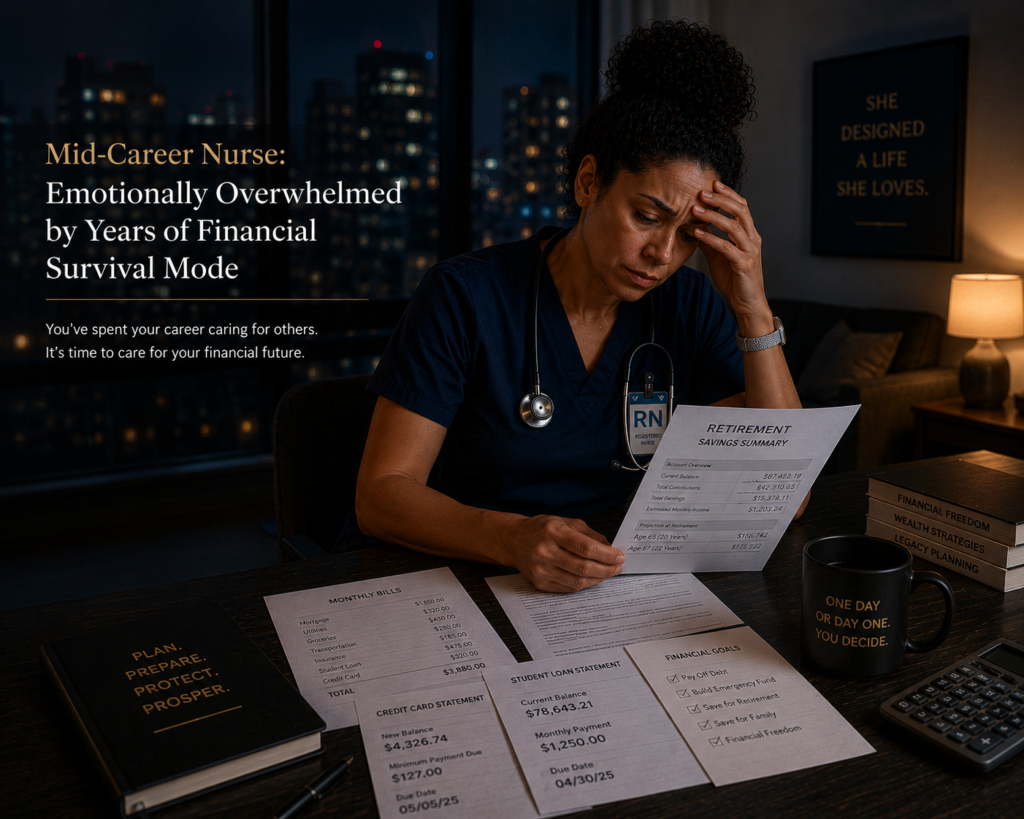
Many Nurses Quietly Reach Midlife Emotionally Exhausted
FFor many nurses, emotional exhaustion does not happen overnight.
It often develops slowly over years of responsibility, sacrifice, and constant caregiving.
Most nurses enter the profession because they genuinely want to help people. They dedicate themselves to their patients, support their families, and push through difficult situations with remarkable resilience.
But over time, constantly giving to others can come at a personal cost.
Many nurses spend decades:
- Working overtime
- Helping family financially
- Sacrificing rest
- Delaying recovery
- Carrying debt
- Postponing financial planning
- Prioritizing everyone else’s needs first
- Ignoring their own emotional needs
- Taking on additional responsibilities
- Putting future goals on hold
During their 20s and 30s, this level of sacrifice may feel manageable.
There is often a belief that things will eventually slow down.
That financial stability will arrive.
That retirement planning can wait.
That recovery can happen later.
But for many nurses, “later” arrives much faster than expected.
As midlife approaches, years of accumulated stress begin becoming more noticeable.
Many nurses quietly begin feeling emotionally depleted despite years of hard work and sacrifice.
Some eventually realize they are:
- Burned out emotionally
- Financially anxious
- Overwhelmed by responsibility
- Concerned about retirement readiness
- Physically exhausted
- Mentally drained
- Frustrated by slow financial progress
- Unsure how long they can continue working at the same pace
This realization can feel emotionally heavy.
Many nurses expected that decades of hard work would create greater peace of mind.
Instead, some find themselves carrying stress that has accumulated over years without fully addressing it.
The emotional burden often extends beyond money alone.
It may include concerns about aging, retirement, healthcare costs, family obligations, career sustainability, and overall quality of life.
For some nurses, this becomes the first time they seriously ask:
“What do I want the next twenty years of my life to look like?”
That question can be uncomfortable.
But it can also be powerful.
Because awareness often creates the opportunity for change.
The good news is that reaching midlife emotionally exhausted does not mean it is too late to improve your situation.
Many nurses begin rebuilding their financial confidence, emotional well-being, and long-term plans during this stage of life.
The key is recognizing that emotional exhaustion is not something to ignore.
It is often a signal that recovery, financial clarity, and intentional planning deserve greater attention moving forward.
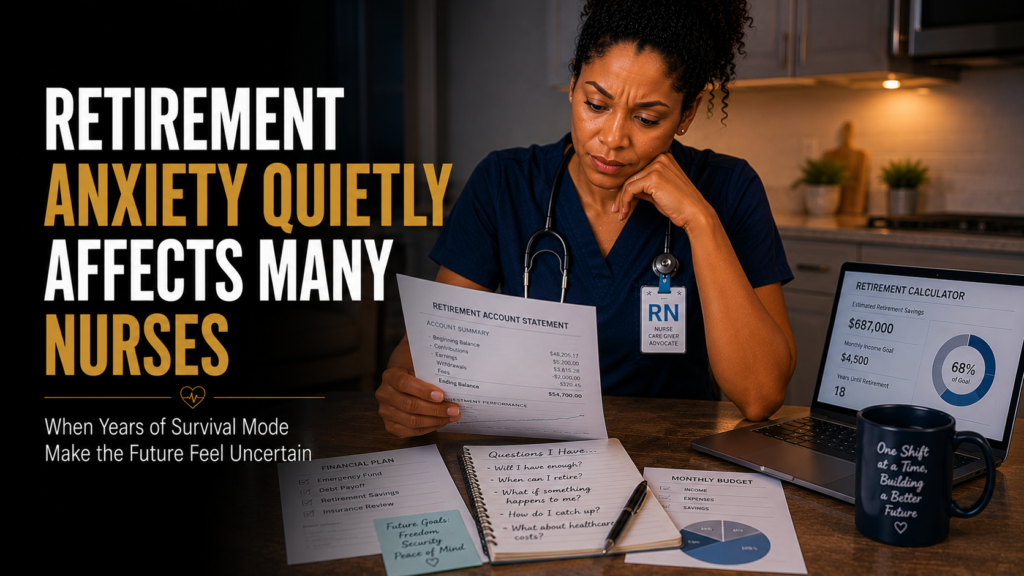
Retirement Anxiety Quietly Affects Many Mid-Career Nurses
Many nurses spend so many years focused on immediate survival that retirement planning quietly gets pushed further and further into the future.
At first, the delay feels temporary.
Life is busy.
Bills need to be paid.
Children need support.
Debt needs attention.
Unexpected expenses keep appearing.
And because financial survival often feels more urgent than retirement planning, many nurses tell themselves they will focus on long-term goals later.
Some nurses assume:
- “I’ll focus on investing later.”
- “I’ll save more once things calm down.”
- “I just need to get through this season first.”
- “I’ll start planning for retirement next year.”
- “Once the debt is gone, I’ll get serious about saving.”
These thoughts are understandable.
The problem is that life rarely becomes completely stress-free.
New responsibilities continue appearing.
Financial obligations continue growing.
And before many nurses realize it, years have passed.
For many mid-career nurses, retirement suddenly feels much closer than it once did.
And that realization can be unsettling.
Some begin noticing:
- Retirement accounts feel behind
- Burnout feels heavier
- Physical exhaustion takes longer to recover from
- Overtime feels less sustainable
- Financial anxiety has not disappeared
- Long-term savings goals feel uncertain
- Healthcare costs continue rising
- The future feels harder to predict
Many nurses reach a point where they begin questioning whether they can continue working at the same pace for another ten, fifteen, or twenty years.
What once felt manageable in their 20s and 30s may feel very different in their 40s and beyond.
The physical demands of nursing can become more noticeable.
Recovery may take longer.
Emotional resilience may feel stretched.
And the idea of relying on overtime indefinitely becomes less appealing.
This is where retirement anxiety often begins quietly appearing.
Not because nurses have done anything wrong.
But because many have spent years prioritizing immediate needs over long-term planning.
That realization can create a deep emotional fear that many nurses rarely discuss openly:
“What if I work this hard for decades and still never feel financially secure?”
For some, that question creates guilt.
For others, it creates frustration.
And for many, it creates motivation to finally take a closer look at their financial future.
The encouraging news is that retirement planning is not all-or-nothing.
Even small changes made consistently can create meaningful progress over time.
Increasing retirement contributions.
Paying down debt.
Learning about investing.
Building emergency savings.
Creating a written financial plan.
Each step helps move a nurse closer to greater financial confidence and long-term stability.
The goal is not perfection.
The goal is progress.
Because financial peace in retirement is often built through many small decisions made consistently over time—not through one dramatic financial breakthrough.
Many nurses have spent years caring for everyone else’s future.
They deserve the opportunity to intentionally plan for their own as well.
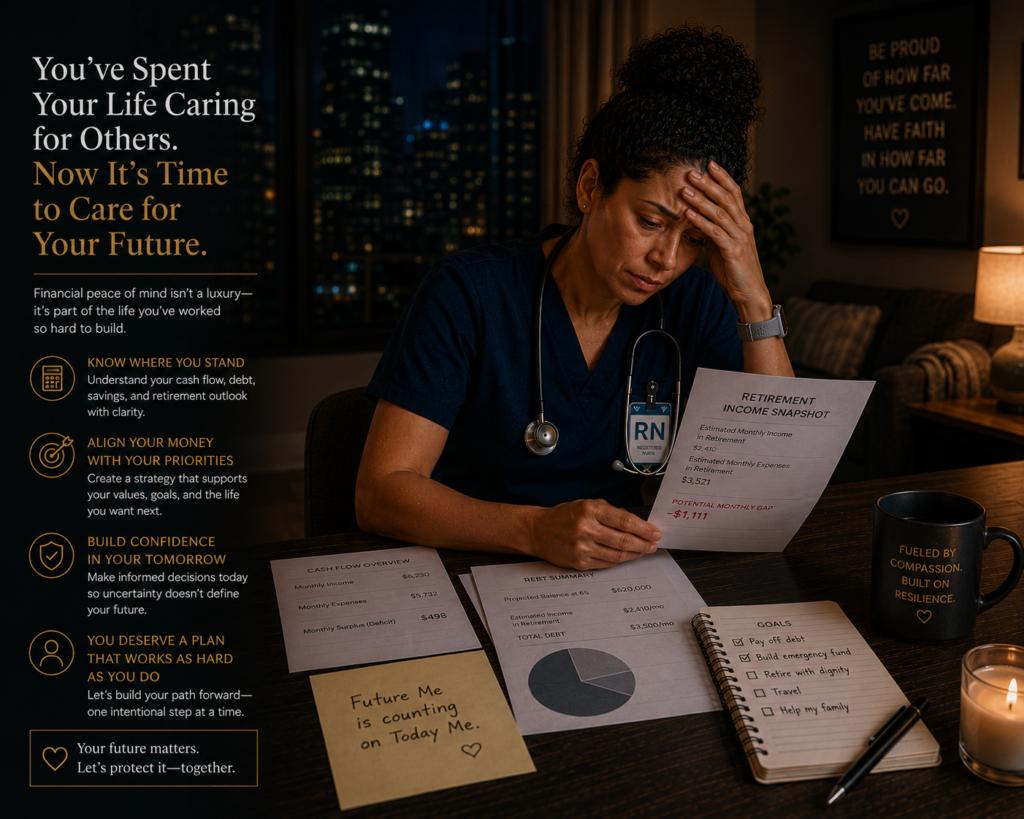
One of the most important things many nurses need to hear is this:
Financial rebuilding does not become impossible simply because someone feels behind.
Many nurses reach their 40s believing they should have accomplished more financially by now.
Some feel frustrated about debt.
Some wish they had started investing earlier.
Others regret years spent focusing on survival instead of long-term financial planning.
Those feelings are understandable.
But they do not determine what happens next.
The reality is that many people begin improving their financial lives much later than expected.
Some start investing in their 40s.
Others begin paying off significant debt in midlife.
Many finally create emergency savings, retirement plans, or wealth-building strategies after years of financial stress.
Financial progress is not reserved only for people who started perfectly.
It is available to people who decide to start intentionally.
And while regret, stress, burnout, or financial anxiety may feel emotionally heavy, meaningful long-term change can still happen gradually through:
- Intentional planning
- Investing consistency
- Reduced financial chaos
- Healthier financial habits
- Emotional recovery
- Stronger financial systems
- Better money management
- Increased financial literacy
- Long-term wealth-building strategies
- Reduced overtime dependency over time
One of the biggest misconceptions about financial recovery is the belief that dramatic change must happen immediately.
In reality, financial stability is often built through small, consistent actions repeated over many years.
A slightly larger retirement contribution.
An extra debt payment each month.
A growing emergency fund.
A new investing habit.
A written financial plan.
These small decisions may seem insignificant in the moment, but over time they can create meaningful transformation.
Midlife can actually become a powerful turning point.
Many nurses have more experience, greater self-awareness, and a clearer understanding of what truly matters than they did earlier in life.
That perspective can become an advantage.
Instead of focusing on what was not done in the past, many nurses begin focusing on what can still be built moving forward.
The goal is not perfection.
The goal is progress.
The goal is creating a future that feels more stable than the past.
Because financial peace is rarely built overnight.
It is usually built through patience, consistency, education, and intentional action over time.
No matter where a nurse starts, every positive financial decision made today has the potential to create a stronger tomorrow.
And for many nurses, that journey begins the moment they stop asking, “Am I too late?” and start asking, “What can I do next?”.

Many Nurses Do Not Need More Shame — They Need a New Financial Direction
Many nurses carry a quiet sense of financial shame because they expected years of hard work to eventually create more peace, stability, and financial security.
After all, they did what they were told to do.
They went to school.
They built careers.
They worked overtime.
They cared for patients.
They sacrificed for their families.
They kept showing up even during some of the most difficult moments of their lives.
Yet despite all of that effort, many nurses still find themselves feeling financially overwhelmed, emotionally exhausted, and uncertain about the future.
That reality can feel deeply discouraging.
Some nurses begin blaming themselves.
Others compare themselves to friends, coworkers, or people online who seem financially ahead.
Some quietly wonder:
“Why does it feel like everyone else has figured this out except me?”
But financial exhaustion is not always a reflection of poor choices.
In many cases, it is the result of carrying enormous responsibilities for years without enough time, energy, or resources left over to focus on long-term financial growth.
Chronic survival mode can affect far more than income alone.
Over time, constant stress may quietly affect:
- Financial habits
- Emotional recovery
- Retirement preparation
- Investing consistency
- Nervous system health
- Long-term planning
- Burnout recovery
- Financial confidence
- Decision-making
- Overall well-being
When people spend years focused on immediate needs, long-term goals often get postponed.
That is not laziness.
That is survival.
And for many nurses, financial exhaustion is not caused by a lack of ambition, discipline, or work ethic.
It is often the result of spending years carrying emotional, physical, and financial pressure simultaneously.
The encouraging news is that shame rarely creates progress.
Awareness does.
Education does.
Intentional action does.
The goal now is not perfection.
And it is not pretending the past never happened.
The goal is slowly creating:
- Healthier financial systems
- Reduced financial chaos
- Intentional long-term planning
- Emotional recovery
- Stronger financial boundaries
- Better money habits
- Greater financial confidence
- More peace over time
Many nurses have spent years helping others recover, heal, and rebuild their lives.
They deserve the opportunity to do the same for themselves financially.
Because financial rebuilding can still happen—even after years of survival mode.
And sometimes the most important financial decision a nurse can make is not working harder.
It is choosing a new direction.
One that prioritizes long-term stability, emotional well-being, and a future that feels more hopeful than overwhelming..

Start Rebuilding Financial Stability More Intentionally
AConclusion
Many nurses reach their 40s financially exhausted despite spending decades working hard, caring for patients, supporting families, and trying to build a better future.
The reality is that many nurses reach their 40s financially exhausted not because they lacked discipline or ambition, but because years of financial pressure, burnout, overtime dependency, debt, and chronic stress quietly accumulated over time.
If you are one of the many nurses who reach their 40s financially exhausted, it is important to remember that financial recovery is still possible. Financial stability is not determined by where you start. It is determined by the actions you take moving forward.
Many nurses reach their 40s financially exhausted and assume they are permanently behind. But financial rebuilding can begin through intentional planning, consistent investing, healthier financial habits, stronger retirement preparation, and reduced financial chaos over time.
The goal is not perfection.
The goal is progress.
The goal is creating a future that feels more stable, more intentional, and more peaceful than the past.
At Nurse Money Lab, we believe nurses who reach their 40s financially exhausted deserve practical financial education, long-term wealth-building strategies, and the opportunity to build lasting financial confidence.
Because it is never too late to improve your financial future.
It is never too late to build wealth.
And it is never too late to create a life that feels defined by financial stability rather than financial survival.

Frequently Asked Questions
Why do many nurses feel financially exhausted in their 40s?
Many nurses feel financially exhausted in their 40s because years of overtime, burnout, debt, rising living expenses, family responsibilities, and survival-mode thinking can quietly accumulate over time. Even nurses with stable incomes may struggle to build long-term financial stability if financial planning, investing, and retirement preparation are repeatedly delayed.
Why do nurses reach their 40s financially exhausted despite working so hard?
Many nurses reach their 40s financially exhausted because hard work alone does not automatically create wealth. Factors such as lifestyle inflation, chronic financial stress, overtime dependency, student loan debt, caregiving responsibilities, and a lack of long-term financial planning can make it difficult to build lasting financial security.
Can financial recovery still happen later in life?
Yes. Many people begin improving their financial situation much later than expected. Building emergency savings, increasing retirement contributions, reducing debt, investing consistently, and creating healthier financial habits can all contribute to meaningful financial recovery over time.
Why does survival mode make long-term planning harder?
Chronic financial stress often keeps people focused on immediate needs rather than future goals. When someone is constantly worried about bills, debt, overtime, or financial emergencies, investing, retirement planning, and wealth building may feel less urgent, even though they remain important.
Can nurses still build long-term wealth after burnout?
Absolutely. Many nurses gradually rebuild financial stability through intentional planning, investing consistency, reduced financial chaos, stronger financial systems, and healthier money habits. Financial progress does not require perfection—it requires consistent action over time.
How can nurses improve retirement readiness in midlife?
Nurses can improve retirement readiness by increasing retirement contributions when possible, reducing high-interest debt, building emergency savings, learning basic investing principles, and creating a written long-term financial plan. Small improvements made consistently can have a significant impact over time.
Is it too late to start investing in your 40s?
No. While starting earlier can provide advantages, many people successfully begin investing in their 40s and still build meaningful wealth over time. Consistency, long-term planning, and disciplined investing habits often matter more than having a perfect starting point.
What is the first step toward financial stability?
For many nurses, the first step is gaining clarity. Understanding income, expenses, debt obligations, savings goals, and retirement readiness can help identify opportunities for improvement. Once financial awareness increases, creating a realistic plan becomes much easier.