

Introduction
Why Some Nurses Avoid Checking Their Bank Accounts During Financial Stress is a question that affects far more healthcare professionals than many people realize. After working long, emotionally demanding shifts, many nurses struggle to face their personal finances…After working a demanding twelve-hour shift, many nurses go through the same routine. They take off their scrubs, drive home exhausted, prepare dinner, care for their families, and try to find a few quiet moments before the next workday begins. Yet, despite everything they accomplish, there is one task many quietly avoid—they do not open their banking app.
It is not because they are irresponsible or careless with money.
In many cases, they already know what they are going to see.
A checking account that is lower than expected.
Credit card balances that continue growing.
Bills scheduled to be withdrawn over the next several days.
Student loan payments.
Mortgage or rent.
Childcare expenses.
Insurance premiums.
Groceries that cost more than they did just a few months ago.
For some nurses, simply seeing those numbers can trigger feelings of stress, disappointment, guilt, or anxiety. Rather than face those emotions immediately, they postpone looking altogether. They tell themselves they will check tomorrow, after payday, after working another overtime shift, or after paying the next round of bills. What begins as a short delay can gradually become a recurring habit known as financial avoidance.
Financial avoidance is more common than many people realize. It is the tendency to avoid financial information because it creates emotional discomfort. This might include ignoring bank account balances, avoiding credit card statements, delaying bill payments until the last possible moment, or postponing conversations about money altogether. Although these behaviors may provide temporary emotional relief, they often increase financial stress over time because important decisions continue to be delayed.
Nurses may be especially vulnerable to this pattern because of the unique pressures of the profession. Healthcare requires constant decision-making, emotional resilience, and physical endurance. Every shift demands attention, compassion, and critical thinking. By the time many nurses arrive home, they have very little emotional energy left to manage another source of stress—especially one involving money.
Ironically, many nurses earn respectable salaries. Yet a higher income does not automatically eliminate financial anxiety. Student loans, inflation, childcare costs, medical expenses, debt, lifestyle inflation, and rising housing costs can quickly consume a paycheck. As financial obligations increase, checking a bank balance may become less about gathering information and more about preparing for emotional disappointment.
Over time, avoiding financial information can create a cycle that becomes increasingly difficult to break. Uncertainty often feels more frightening than reality itself. Without regularly reviewing income, expenses, savings, and spending habits, financial confidence slowly begins to disappear. Even nurses who are capable of improving their financial situation may feel overwhelmed because they no longer have a clear picture of where their money is going.
The encouraging news is that financial avoidance is not a permanent habit. Like many behaviors influenced by stress, it can be changed through awareness, consistency, and small intentional actions. Building financial confidence does not require perfection or a large salary increase. It begins with developing the courage to face financial reality one step at a time.
In this article, you’ll learn why many nurses avoid checking their bank accounts during periods of financial stress, how avoidance can quietly increase anxiety, and practical strategies to rebuild financial confidence without adding more pressure to an already demanding career. Small, consistent habits can gradually replace fear with clarity, allowing nurses to make informed financial decisions that support both their financial future and their overall well-being.
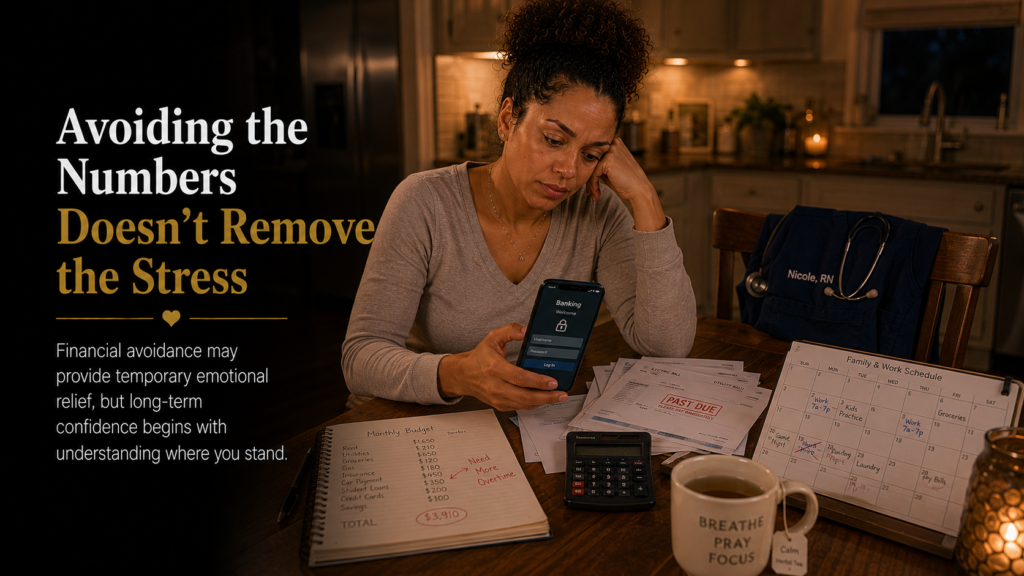
Why Financial Avoidance Feels Easier Than Facing Reality
For many nurses, avoiding a bank account is rarely about not caring. More often, it is a protective response to the emotional weight that financial uncertainty carries. After spending an entire shift making life-saving decisions, managing multiple patients, comforting grieving families, and responding to constant demands, the last thing many nurses want to confront is another source of stress waiting on their phone screen.
Checking a bank balance seems like a simple task. In reality, it can trigger a cascade of emotions that extend far beyond the numbers themselves. A lower-than-expected balance may immediately bring thoughts of upcoming bills, credit card debt, rising grocery costs, student loans, or another overtime shift that now feels unavoidable. For some nurses, the banking app becomes associated with disappointment rather than information.
Psychologists often describe avoidance as a short-term coping strategy. When something causes emotional discomfort, avoiding it temporarily reduces anxiety. The brain learns that postponing the stressful situation provides immediate relief, even if only for a few hours or days. Unfortunately, this temporary relief reinforces the habit, making it more likely that the same behavior will occur again.
Financial avoidance often develops gradually.
A nurse may skip checking her account after an expensive weekend.
The next week, she delays looking until after payday.
Eventually, checking her finances becomes something she only does when absolutely necessary.
Without realizing it, avoidance has become part of her financial routine.
Many nurses tell themselves things like:
- “I’ll check after my next paycheck.”
- “I already know there’s not much in there.”
- “I don’t want to ruin my day.”
- “I’ll deal with it after I work some overtime.”
- “Maybe it won’t be as bad next week.”
- “I’m too exhausted to think about money tonight.”
These thoughts are understandable. They offer temporary emotional protection from feelings of fear, guilt, or disappointment. However, they also delay important financial decisions that could improve the situation. Bills continue arriving, subscriptions continue renewing, interest continues accumulating, and opportunities to adjust spending are often missed because the financial picture remains unclear.
For nurses, emotional fatigue can make this pattern even stronger. Healthcare professionals spend their days focusing on the needs of others, frequently placing their own well-being last. After twelve hours of physical work, emotional conversations, documentation, and constant multitasking, decision fatigue becomes very real. Financial planning requires mental energy, and when that energy has already been spent at work, avoiding financial responsibilities can feel easier than confronting them.
Another reason financial avoidance feels safer is that uncertainty sometimes appears less painful than certainty. As long as a nurse does not look at the numbers, there is still room to hope that things are not quite as difficult as they seem. Opening the banking app removes that uncertainty and replaces it with reality. Even when reality is manageable, the anticipation often feels worse than the truth itself.
Ironically, avoiding financial information rarely reduces stress over the long term. Instead, it often allows anxiety to grow because unanswered questions remain in the background of everyday life. The mind continues wondering whether there is enough money for groceries, whether an automatic payment will clear, or whether another overtime shift will be necessary. These unanswered questions consume emotional energy long before any financial problem is actually solved.
Facing financial reality does not mean everything must be fixed immediately. It simply means replacing uncertainty with information. Even when finances are challenging, knowing where you stand provides a foundation for making thoughtful decisions. Clarity reduces guesswork, and every small step toward understanding your finances builds confidence for the next one.
Financial wellness is not about never experiencing financial stress. It is about developing the confidence to face your financial situation honestly, make informed choices, and gradually improve your circumstances. For many nurses, the first step is simply opening the banking app—not because the numbers are perfect, but because avoiding them no longer serves the life they want to build.

The Emotional Cycle of Financial Stress and Avoidance
Financial avoidance rarely begins with poor money management. More often, it begins with emotional overwhelm.
Many nurses do not intentionally ignore their finances because they are irresponsible. They avoid looking because they anticipate feeling stressed, disappointed, or discouraged. Unfortunately, this creates a cycle that becomes increasingly difficult to break. What starts as an effort to protect emotional well-being often leads to even greater financial anxiety over time.
Understanding this cycle is important because awareness is the first step toward changing it.
For many nurses, the pattern begins with financial pressure. Rising living expenses, unexpected emergencies, increasing debt, inflation, or the cost of supporting a family create ongoing concerns about money. Even nurses with stable careers and competitive salaries are not immune to these pressures. Higher incomes do not always translate into greater financial security, particularly when expenses continue rising alongside earnings.
As financial stress builds, many nurses begin worrying about their current financial situation long before they actually review it. Instead of checking account balances, reviewing transactions, or updating their budget, they imagine the worst-case scenario. Their thoughts may sound familiar:
- “I probably spent more than I should have.”
- “There’s probably less money than I think.”
- “I’ll check after my next paycheck.”
- “I don’t want another reason to feel stressed today.”
- “Maybe everything will look better next week.”
Although these thoughts provide temporary emotional relief, they also reinforce avoidance. The longer financial information goes unchecked, the greater the uncertainty becomes. Small concerns gradually transform into larger worries simply because there are unanswered questions.
Without realizing it, many nurses become trapped in a repeating emotional cycle:
Financial stress leads to financial avoidance.
Financial avoidance creates uncertainty.
Uncertainty increases anxiety.
Anxiety makes financial tasks feel even more overwhelming.
The cycle then begins again.
Over time, this pattern affects much more than a bank account. It begins influencing emotional well-being, confidence, and decision-making. Nurses may postpone creating a budget, delay paying down debt, ignore retirement contributions, or avoid setting financial goals altogether because every financial task feels emotionally exhausting before it even begins.
Ironically, uncertainty is often more stressful than reality.
Many nurses eventually discover that the financial situation they feared was manageable once they actually reviewed their accounts. While the numbers may not have been ideal, having accurate information allowed them to create a plan. Before opening the banking app, however, their imagination often created a scenario far worse than the truth.
This is a common response to chronic stress. The human brain naturally focuses on protecting itself from perceived threats. During prolonged periods of emotional or financial strain, even routine financial responsibilities can begin feeling emotionally significant. Opening a banking app, reading a credit card statement, or reviewing monthly expenses may trigger the same stress response as much larger life challenges because the brain has learned to associate money with danger rather than stability.
For nurses, this emotional burden is often intensified by the demands of healthcare. After caring for patients throughout an exhausting shift, there may be very little emotional energy left for personal financial responsibilities. Decision fatigue, physical exhaustion, and compassion fatigue all reduce the motivation to tackle tasks that require concentration and emotional resilience.
The encouraging news is that this cycle can be interrupted.
Breaking financial avoidance does not require solving every money problem in a single day. Instead, it begins with one small decision to replace uncertainty with information. Checking a bank balance, reviewing recent transactions, updating a budget, or setting aside ten minutes each week to review finances can gradually reduce the fear associated with money. Each small action builds confidence because it shifts attention away from imagined outcomes and toward practical solutions.
Financial confidence grows through consistency rather than perfection. Every time a nurse chooses to face their finances instead of avoiding them, they weaken the emotional cycle that has been keeping them stuck. Over time, the banking app becomes less of a source of anxiety and more of a tool for making informed decisions, creating financial stability, and building a future with greater peace of mind.

Real Nurse Scenario: Ignoring the Banking App Until Payday
Jessica has been a registered nurse for nearly eight years. She works full-time on a busy medical-surgical unit, frequently picks up overtime, and is known by her coworkers as someone who always volunteers to help when the unit is short-staffed. Her patients appreciate her compassion, and her managers trust her professionalism. From the outside, Jessica appears to have everything under control.
What most people do not see is the anxiety she feels every time her phone displays a notification from her bank.
Almost every evening after work, Jessica receives alerts about automatic bill payments, direct deposits, credit card transactions, or account balances. Instead of opening the notification, she swipes it away. She tells herself she will look later, preferably after her next paycheck arrives.
Days sometimes pass before she checks her account.
It is not because she does not care about her finances.
It is because she already expects bad news.
She worries there may not be enough money left after paying rent, utilities, groceries, daycare, insurance, and student loans. Even though she works hard and earns a good income, the rising cost of living has made every paycheck feel smaller than the last.
Whenever she thinks about opening her banking app, a flood of questions immediately fills her mind.
- Did another automatic payment come out?
- Did I forget about a subscription?
- Is my credit card balance higher than I expected?
- Will I have enough for groceries this week?
- Should I pick up another overtime shift?
- Can I afford to take a day off?
Rather than face those questions after an already exhausting twelve-hour shift, Jessica chooses not to look.
For a few hours, she feels slightly better.
She convinces herself that avoiding the information gives her one less thing to worry about that day.
However, the relief never lasts.
The next morning, the same uncertainty returns. Throughout her shift, she wonders whether she has enough money in her account, whether upcoming bills will clear successfully, or whether she will need to work another weekend to stay ahead financially. Although she has not actually looked at her account, her mind continues creating worst-case scenarios.
Eventually, payday arrives.
Only then does Jessica open her banking app.
Instead of feeling relieved, she immediately begins paying overdue bills, transferring money between accounts, and trying to catch up before the next pay period begins. Because she waited so long to review her finances, every decision now feels urgent. What could have been several small adjustments throughout the month has become one overwhelming financial task.
Jessica’s experience is not unusual.
Many nurses silently repeat this pattern every pay period. They avoid checking their finances because they fear what they might discover, yet the uncertainty often creates far more stress than the actual numbers. Financial avoidance becomes a cycle where temporary emotional relief is followed by even greater anxiety, making each paycheck feel like a race to recover rather than an opportunity to build financial stability.
The truth is that checking a bank account does not create financial problems—it simply reveals them. Whether the balance is higher or lower than expected, accurate information provides the opportunity to make informed decisions. Waiting until payday rarely improves the situation. Instead, regular financial check-ins allow nurses to identify spending patterns, adjust their budgets, avoid unnecessary overdraft fees, and make thoughtful choices before financial challenges become emergencies.
Jessica eventually decided to change one small habit.
Instead of waiting until payday, she committed to spending just five minutes every Sunday evening reviewing her bank account, upcoming bills, and weekly spending. At first, the process still felt uncomfortable. But after several weeks, something unexpected happened.
Her anxiety began to decrease.
Because she knew exactly where she stood financially, she spent less time imagining worst-case scenarios and more time making practical decisions. She no longer viewed her banking app as something to fear. Instead, it became a tool that helped her stay informed, feel prepared, and gradually regain confidence in managing her money.
Her financial situation did not change overnight.
But her relationship with money did.
Sometimes, the first step toward financial peace is not earning more—it is replacing uncertainty with clarity.

How Avoiding Your Finances Can Increase Anxiety
Many people believe that avoiding financial information protects them from stress. For a brief moment, it often feels that way. Ignoring a banking app notification, delaying a credit card statement, or postponing a monthly budget review can provide temporary emotional relief because it allows difficult feelings to be pushed aside.
However, that relief is usually short-lived.
Instead of eliminating financial stress, avoidance often gives anxiety more room to grow. Without accurate information, the mind naturally begins filling in the gaps. Questions replace facts, assumptions replace certainty, and imagined worst-case scenarios often become far more frightening than reality itself.
For nurses, this emotional response is understandable.
Healthcare professionals spend every shift solving problems, responding to emergencies, and making rapid decisions under pressure. After hours of caring for others, many nurses have very little emotional energy left to manage their personal finances. When they finally arrive home, checking a bank account may feel like opening the door to another crisis.
As a result, financial uncertainty quietly follows them throughout the day.
A nurse may be administering medications while wondering whether a utility payment has already been withdrawn.
During lunch break, she may question whether there is enough money left for groceries.
Driving home, she may wonder if another overtime shift will be necessary just to stay ahead.
Even while trying to relax with family, unanswered financial questions continue occupying valuable mental space.
Over time, these constant thoughts create emotional fatigue that extends far beyond money itself.
Financial avoidance can lead to:
- Increased anxiety about everyday expenses
- Difficulty concentrating at work
- Trouble relaxing during time off
- Poor sleep caused by racing thoughts
- Feelings of guilt or embarrassment about finances
- Increased dependence on overtime income
- Reduced confidence in making financial decisions
- Constant worry about unexpected emergencies
Ironically, many of these worries exist because the financial situation remains unknown. Without regularly reviewing account balances, spending habits, or upcoming bills, uncertainty becomes a permanent source of stress. The mind continues preparing for problems that may never actually occur.
Research has consistently shown that uncertainty often creates more anxiety than certainty. Human beings naturally prefer knowing the facts—even when the facts are challenging—because certainty allows the brain to begin planning solutions. Uncertainty, on the other hand, keeps the brain searching for possible threats, maintaining a heightened state of alertness that can feel emotionally exhausting.
For nurses already managing demanding workloads, this constant mental vigilance can become overwhelming. Their nervous system may never feel like it has permission to fully relax because financial concerns remain unresolved in the background. Even enjoyable activities, such as spending time with family, reading a book, or watching a movie, may be interrupted by recurring thoughts about money.
The good news is that financial clarity often reduces anxiety more quickly than people expect.
Checking a bank balance does not automatically improve financial circumstances, but it does replace uncertainty with facts. Once nurses understand exactly where they stand financially, they can begin making intentional decisions instead of reacting emotionally to imagined scenarios. A realistic budget can be adjusted. Spending habits can be reviewed. Savings goals can be created. Small financial wins become easier to recognize because progress is measurable rather than uncertain.
Many nurses discover that the financial situation they feared was not as overwhelming as they imagined. Others realize changes are needed, but they also gain something equally valuable—a plan. Having a plan often brings far more emotional relief than continuing to avoid the problem altogether.
Financial peace is rarely created by ignoring money.
It is created by understanding it.
Every time a nurse chooses to review their finances with honesty instead of fear, they take another step toward greater confidence, reduced anxiety, and long-term financial wellness. Progress does not require perfect finances—it requires the willingness to replace uncertainty with awareness, one small decision at a time.

Financial Avoidance Can Affect Relationships and Mental Health
Financial stress is often viewed as a personal struggle, but its effects rarely remain limited to a person’s bank account. When financial avoidance becomes a long-term habit, it can quietly influence relationships, emotional well-being, self-confidence, and overall quality of life. Many nurses work tirelessly to care for others while carrying financial worries they rarely discuss with anyone—not even the people closest to them.
At first, avoiding conversations about money may seem harmless. A nurse might decide not to mention growing credit card balances to a spouse or delay discussing financial goals with their family because they do not want to create additional stress. Others may feel embarrassed that, despite working full-time in a respected profession, they still struggle financially. Instead of asking for support, they choose to carry the burden alone.
Unfortunately, silence often increases emotional isolation.
Money is one of the most common sources of stress in households, and avoiding financial conversations can create misunderstandings between partners and family members. One person may assume everything is fine because nothing has been said, while the other quietly worries about every purchase, every bill, and every unexpected expense. Over time, the lack of communication can lead to frustration, resentment, and unnecessary conflict.
For nurses, emotional fatigue can make these conversations feel even more difficult. After spending an entire shift communicating with patients, physicians, coworkers, and families, many simply do not have the emotional energy left to talk about finances when they arrive home. Avoidance becomes easier than vulnerability.
Financial stress can also affect relationships in less obvious ways.
A nurse who constantly worries about money may begin declining invitations to spend time with friends because they are trying to save money. They may avoid vacations, family outings, or celebrations, not because they do not want to participate, but because they are worried about the financial impact. Eventually, financial anxiety can begin shrinking both social connections and personal enjoyment.
Over time, chronic financial stress may contribute to:
- Increased irritability and emotional exhaustion
- Difficulty communicating with a spouse or partner about money
- Feelings of shame or embarrassment surrounding finances
- Social withdrawal from friends and family
- Reduced confidence and self-esteem
- Greater emotional dependence on overtime income
- Persistent worry that interferes with daily life
- Increased risk of professional burnout
Many nurses also begin tying their self-worth to their financial situation. They may believe they should have more savings by now, less debt, or greater financial stability because of their profession. When reality does not match those expectations, feelings of guilt and self-criticism often follow.
The truth is that financial challenges do not define a person’s intelligence, work ethic, or value.
Healthcare professionals face many of the same economic pressures affecting families across the country, including inflation, rising housing costs, childcare expenses, insurance premiums, and student loan debt. Experiencing financial stress is not a personal failure—it is a reality many hardworking professionals face.
The encouraging news is that honest communication can be one of the most powerful tools for reducing financial stress. Talking openly with a spouse, trusted friend, financial coach, or advisor can transform money from an isolated burden into a shared problem with practical solutions. Financial conversations do not have to revolve around blame or regret. Instead, they can focus on goals, priorities, and small steps toward improvement.
Just as importantly, nurses should remember that mental well-being deserves the same attention they give their physical health. Chronic financial anxiety can take a real emotional toll, and seeking support is a sign of strength—not weakness. Whether that support comes from financial education, counseling, trusted relationships, or healthier financial habits, taking action can help reduce the emotional burden that financial avoidance creates.
Building financial wellness is about much more than balancing a budget. It is about creating a life where money no longer dominates every conversation, every decision, or every moment of rest. As financial confidence grows, relationships often become stronger, communication becomes more open, and emotional well-being has room to recover.

Small Financial Habits That Help Nurses Regain Control
When finances feel overwhelming, many nurses believe they need a dramatic solution. They imagine creating the perfect budget, eliminating all debt within months, or completely changing their spending habits overnight. While those goals may be inspiring, they can also feel so intimidating that they prevent people from taking the first step.
The reality is that lasting financial confidence is rarely built through one major decision.
It is built through small, consistent habits repeated over time.
Just as nurses understand that a patient’s recovery often happens one day at a time, financial wellness develops through gradual progress rather than instant transformation. Small actions may not seem significant individually, but together they create lasting change.
The first habit is simply becoming aware of where your money goes.
Many nurses are surprised to discover that they are not overspending on large purchases but on dozens of small expenses that accumulate throughout the month. Coffee after every shift, food delivery during busy workweeks, impulse purchases while shopping online, unused subscriptions, and convenience spending can quietly consume hundreds of dollars without being noticed.
This does not mean nurses should eliminate every enjoyable purchase.
Instead, awareness allows spending to become intentional rather than automatic.
A second helpful habit is scheduling a weekly “money check-in.”
Rather than only looking at finances when bills are due or payday arrives, set aside just ten to fifteen minutes once a week to review:
- Current bank account balances
- Upcoming bills
- Recent transactions
- Credit card balances
- Weekly spending
- Savings progress
Treat this appointment the same way you would treat an important meeting at work. By making it a regular routine, financial management becomes less emotional and more predictable. Instead of reacting to surprises, you begin anticipating them.
Another powerful habit is automating positive financial behaviors whenever possible.
Automation removes the need to make repeated decisions, especially during busy weeks when mental energy is limited. Consider automating:
- Monthly savings transfers
- Retirement contributions
- Bill payments
- Emergency fund deposits
- Debt payments above the minimum amount
Even small automatic transfers—such as twenty-five or fifty dollars per paycheck—can grow into meaningful savings over time. Consistency matters far more than the starting amount.
Nurses can also regain confidence by creating a simple spending plan rather than a restrictive budget.
Many people associate budgeting with giving things up, but an effective spending plan is simply a roadmap that tells your money where to go before it disappears. Instead of wondering where every paycheck went, you intentionally allocate funds toward essentials, savings, debt reduction, and personal enjoyment.
Including room for enjoyable spending is important because financial wellness should be sustainable. Completely eliminating every luxury often leads to frustration and burnout. A realistic financial plan recognizes that life should include both responsibility and enjoyment.
Building an emergency fund is another habit that dramatically reduces financial anxiety.
Unexpected expenses are not a matter of if—they are a matter of when. Car repairs, medical bills, home maintenance, or family emergencies can quickly disrupt even a well-planned budget. Having emergency savings provides something that money alone cannot buy: peace of mind.
If saving several thousand dollars feels impossible, begin with a smaller milestone.
Aim for your first:
- $250
- $500
- $1,000
Each milestone creates momentum and reinforces the belief that financial progress is possible.
Another valuable habit is limiting financial comparison.
Many nurses compare themselves to coworkers who appear to be thriving financially. They may see colleagues purchasing new vehicles, taking luxury vacations, buying larger homes, or posting expensive experiences on social media. What they do not see are the full financial circumstances behind those decisions.
Comparing your financial journey to someone else’s can create unnecessary pressure and encourage spending that does not align with your own goals. Financial success should be measured by your progress—not by someone else’s appearance of success.
Finally, celebrate small victories.
Paying off one credit card.
Saving your first $500.
Completing four weekly money check-ins.
Skipping unnecessary impulse purchases.
Reviewing your finances without anxiety.
Each of these accomplishments deserves recognition because they represent something much larger than dollars—they represent a healthier relationship with money.
Financial confidence grows through repeated positive experiences. Every small habit strengthens your ability to make informed decisions, reduces uncertainty, and reminds you that progress is possible.
You do not need to become financially perfect to regain control.
You simply need to take the next small step—and then repeat it tomorrow.

Building Confidence One Financial Decision at a Time
Financial confidence is often misunderstood.
Many people believe confidence comes after reaching a certain salary, paying off every debt, or building a large savings account. They assume there will be a moment when financial stress simply disappears and managing money suddenly feels easy.
For most nurses, that moment never arrives.
Instead, financial confidence grows through experience. It develops every time you make one thoughtful financial decision, follow through on a commitment to yourself, and prove that you are capable of managing your money—even if your finances are not yet perfect.
Think about your nursing career.
When you graduated from nursing school, you probably did not feel completely confident during your first shift. You learned by showing up every day, asking questions, gaining experience, and practicing your clinical skills. Over time, tasks that once felt intimidating became second nature because confidence was built through repetition, not perfection.
Managing money works the same way.
Every positive financial choice strengthens your confidence.
Every weekly budget review reinforces healthy habits.
Every savings contribution demonstrates consistency.
Every debt payment represents progress.
Every informed spending decision reminds you that you are in control.
Financial confidence is not built by never making mistakes. It is built by learning from those mistakes and continuing to move forward.
Many nurses become discouraged because they focus entirely on how far they still have to go. They compare themselves to people who appear financially successful or regret decisions they made years ago. While reflection can be helpful, living in the past often prevents meaningful progress in the present.
Your financial journey begins where you are today—not where you wish you had started.
Perhaps you are rebuilding after unexpected medical expenses.
Perhaps student loans have delayed your financial goals.
Perhaps inflation has stretched your household budget further than you expected.
Perhaps you’re supporting children, aging parents, or other family members while trying to save for your own future.
These realities do not mean you have failed.
They simply mean your financial journey is uniquely yours.
One of the most powerful mindset shifts nurses can make is replacing the question, “Why am I so far behind?” with “What is one positive financial decision I can make today?”
That decision might be:
- Reviewing your bank account without fear.
- Saving an extra $20 this week.
- Canceling a subscription you no longer use.
- Bringing lunch to work instead of ordering takeout.
- Increasing your retirement contribution by 1%.
- Scheduling your weekly money check-in.
- Paying a little extra toward your highest-interest debt.
- Reading one chapter of a personal finance book.
- Setting a realistic savings goal for the month.
None of these actions will instantly transform your financial future.
But together, they create momentum.
Momentum is powerful because each small success makes the next decision feel easier. As healthy habits become routine, financial management begins to feel less overwhelming and more empowering. The fear that once surrounded your banking app, budget, or monthly bills gradually gives way to familiarity and confidence.
It is also important to celebrate progress that cannot be measured by dollars alone.
Have you stopped avoiding your bank account?
Have you started talking openly about money with your spouse?
Do you feel less anxious before payday than you did six months ago?
Have you developed a routine for reviewing your finances each week?
These are meaningful victories because they reflect a healthier relationship with money.
Financial wellness is about more than numbers on a statement. It is about reducing stress, increasing confidence, creating opportunities, and giving yourself the freedom to make decisions based on your goals instead of your fears.
As a nurse, you spend your career helping other people build healthier lives.
You deserve to experience that same sense of security and stability in your own financial life.
No matter where you are today, remember this:
You do not need to have everything figured out before you begin.
You only need the courage to make one good financial decision today.
Tomorrow, make another.
Over time, those small decisions become lasting habits, those habits become confidence, and that confidence becomes the foundation for long-term financial freedom.
Your financial future is not defined by yesterday’s mistakes.
It is shaped by the choices you make starting today.
Conclusion
For many nurses, financial stress has very little to do with laziness or a lack of income. It often begins with emotional exhaustion. After spending long shifts caring for patients, making critical decisions, and supporting others through difficult moments, facing personal finances can feel like one more challenge at the end of an already overwhelming day.
That is why so many nurses delay opening their banking app, avoid reviewing monthly statements, or promise themselves they will deal with money after the next paycheck arrives.
The avoidance makes sense.
But it also keeps financial anxiety alive.
Throughout this article, we’ve explored how financial avoidance develops, why it feels emotionally easier than facing reality, and how it can quietly affect confidence, relationships, and mental well-being. More importantly, we’ve seen that breaking this cycle does not require earning a six-figure salary, winning the lottery, or becoming a financial expert overnight.
It starts with one small decision.
Opening your banking app.
Reviewing your spending.
Scheduling a weekly money check-in.
Saving your first $25.
Talking honestly about money with someone you trust.
Each of these actions replaces uncertainty with clarity. And clarity is one of the most powerful tools for reducing financial stress.
Remember that financial wellness is not measured by perfection.
You do not have to eliminate every debt before you can feel confident.
You do not have to reach a certain income before you deserve financial peace.
You do not have to know everything about investing, budgeting, or retirement planning before taking your first step.
Financial confidence grows through consistency.
The same determination that helped you succeed in nursing school, care for patients during difficult shifts, and overcome professional challenges can also help you build a healthier relationship with money.
Give yourself permission to start where you are.
Celebrate progress instead of perfection.
Replace fear with information.
Replace avoidance with small, manageable habits.
Over time, those habits become routines, those routines become confidence, and that confidence creates lasting financial freedom.
As a nurse, you spend your career helping others heal, recover, and build healthier futures.
You deserve the same opportunity to build a healthier financial future for yourself.
The next time your banking app sends a notification, don’t think of it as bad news waiting to happen.
Think of it as an opportunity to take one more step toward the financial peace you have worked so hard to achieve.

Frequently Asked Questions
Why do nurses avoid checking their bank accounts?
Many nurses avoid checking their bank accounts because financial information can trigger anxiety, especially after long, emotionally demanding shifts. Delaying financial tasks may provide temporary relief, but it often increases stress over time by creating uncertainty.
Can financial avoidance make anxiety worse?
Yes. Avoiding your finances often creates uncertainty, and uncertainty tends to increase stress. Regularly reviewing your bank account and budget can replace fear with clarity, helping you feel more in control of your financial situation.
Is financial avoidance a sign of poor money management?
No. Financial avoidance is usually an emotional response to stress rather than a lack of financial knowledge. Many responsible, hardworking nurses experience financial anxiety during difficult seasons of life.
How can nurses overcome financial avoidance?
Start with small, consistent habits such as checking your bank account once a week, reviewing upcoming bills, creating a simple spending plan, and automating savings whenever possible. Small actions build confidence and reduce financial stress over time.
How often should nurses review their finances?
A weekly money check-in is a practical routine for most nurses. Spending just 10–15 minutes reviewing account balances, recent transactions, upcoming bills, and savings goals can prevent surprises and reduce anxiety.
Can improving financial habits improve mental well-being?
Yes. While healthier financial habits may not immediately change your income, they often reduce uncertainty and provide a greater sense of control. Many nurses find that becoming more aware of their finances leads to lower stress and improved emotional well-being.
What is the first step toward building financial confidence?
The first step is simply understanding where you stand. Opening your banking app, reviewing your current balance, and creating a realistic spending plan are small actions that can lead to long-term financial confidence.
Disclaimer
The information provided in this article is for educational and informational purposes only and should not be considered financial, legal, tax, or investment advice. While NurseMoneyLab strives to provide accurate and up-to-date information, every nurse’s financial situation is unique. Decisions regarding budgeting, debt repayment, investing, insurance, retirement planning, or other financial matters should be based on your individual goals, income, expenses, and circumstances. Consider consulting a qualified financial advisor, accountant, or other licensed professional before making significant financial decisions. NurseMoneyLab is committed to empowering nurses with financial education but cannot guarantee specific financial outcomes or results.